



Dynamic Probing Light (DPL)
At Geo Costa Rica, we perform Dynamic Probing Light (DPL) tests to investigate how ground resistance varies with depth using compact, portable equipment. This method is particularly useful where site access restricts the use of larger equipment.
Investigating how ground resistance changes with depth
DPL (Dynamic Probing Light) is a dynamic penetration test in which a cone is driven into the ground by controlled impacts, recording resistance as it advances.
Where does ground resistance change, and how does it vary with depth?
As the cone advances, the number of blows required to achieve a specified penetration is recorded. These measurements provide a dynamic penetration resistance profile of the ground.
Observed variations can help identify changes in the subsurface and provide useful information for soil studies and other geotechnical investigations.
Geotechnical investigation where site access is a constraint
The size and mobility of DPL equipment make it possible to work in places where bringing in larger machinery or exploration rigs may be difficult.

Especially useful when mobility matters
The equipment can be transported and operated manually, facilitating investigations on properties where site conditions make it difficult to bring in larger drilling systems.
Portability is an advantage of DPL, but it does not automatically make it the appropriate method for every site. Selection must be based on ground conditions and the investigation objectives.
A cone, controlled impact energy, and a continuous blow-count record
The test uses a lightweight dynamic probing system to record the resistance offered by the ground as the cone advances.
Record how many blows are needed for the cone to advance
A typical DPL setup uses a 10 kg with an approximate drop height of 50 cm.
During testing, the number of blows required for successive increments of cone penetration is recorded. The result is commonly expressed as N10, representing the number of blows per 10 cm of penetration.
Greater ground resistance generally requires more blows to achieve the same penetration.
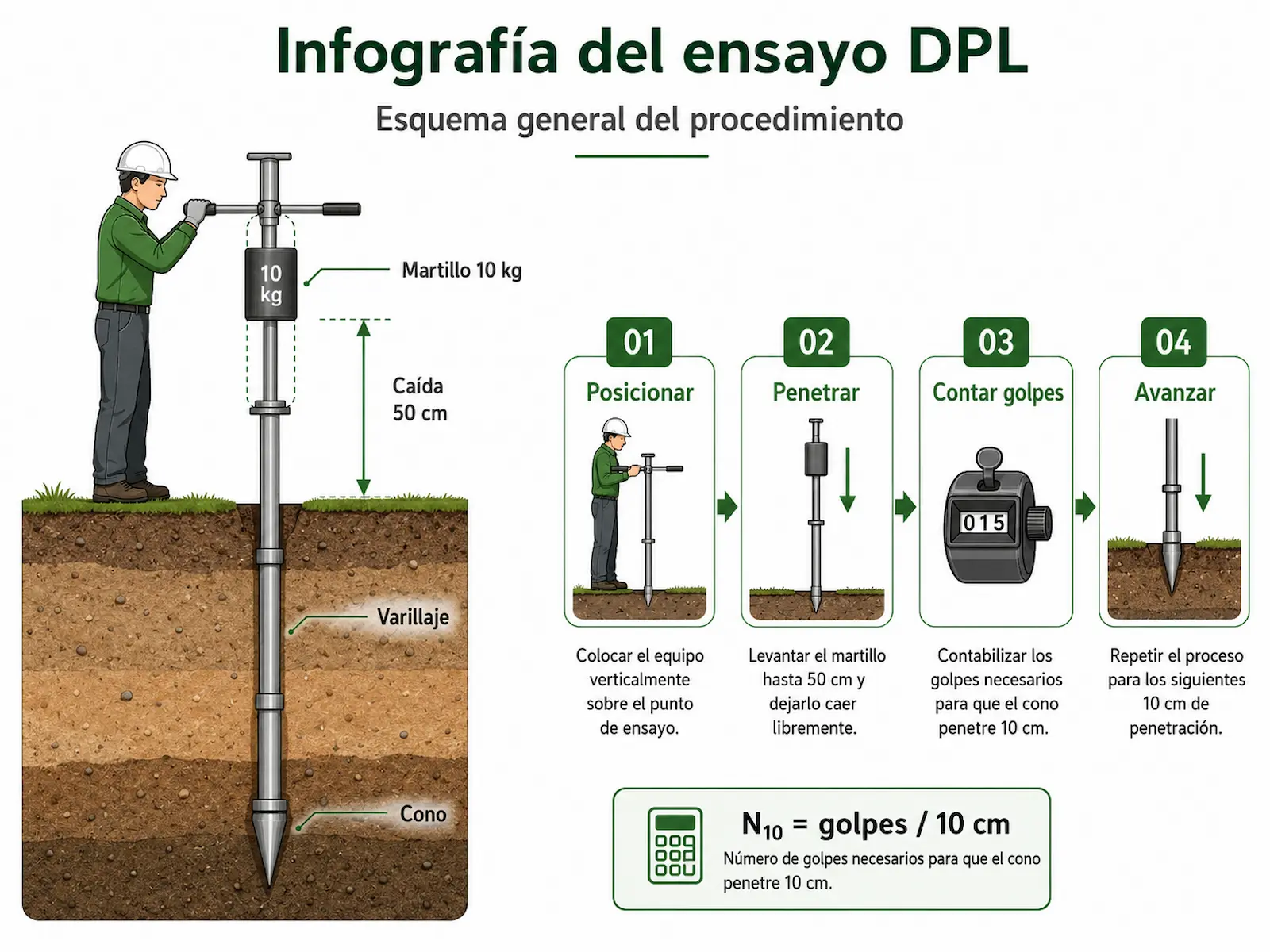
Position
The equipment is positioned vertically over the investigation point.
Drive
The hammer delivers the energy needed to drive the cone progressively into the ground.
Count
The number of blows required for each penetration interval is recorded.
Advance
The process continues to develop a resistance record with depth.
From blow counts to a ground resistance profile
By relating recorded values to depth, we can observe variations in the dynamic resistance of the ground and identify intervals requiring particular interpretation.
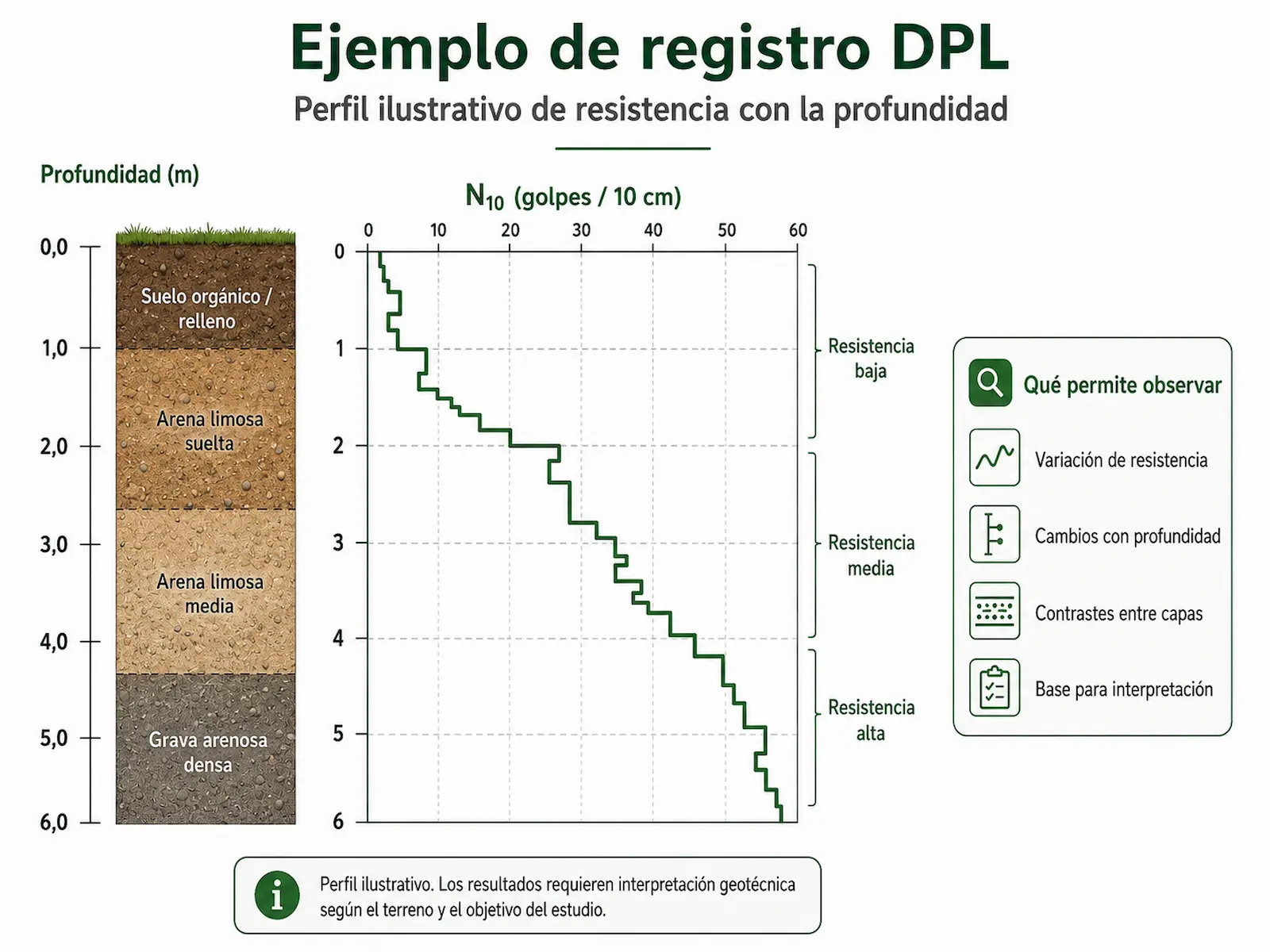
Changes in resistance help reveal variations within the subsurface
DPL records can identify increases, decreases, and contrasts in resistance with depth.
DPL records resistance; interpretation explains what it means
Because the test does not recover samples, changes in the record should not automatically be interpreted as changes in soil type. At Geo Costa Rica, we integrate the results with available site information and, when appropriate, other investigation methods.
DPL and SPT investigate the ground in different ways
Both tests use dynamic penetration, but their equipment, procedures, and scope differ. The choice depends on the technical question and project conditions.
DPL
- Compact, portable equipment.
- Uses a penetration cone.
- Records dynamic resistance with depth.
- Does not recover ground samples.
- Can be particularly useful where access is difficult.
SPT
- Performed within a borehole investigation.
- Uses a split-spoon sampler.
- Records penetration resistance.
- Allows recovery of a disturbed sample.
- Provides additional information for subsurface characterization.
Some ground conditions require a different investigation method
Very dense, gravelly, cemented, or rocky materials may limit penetration. Some projects also require samples or investigation to greater depths.
Common questions about DPL testing
Are DPL and SPT the same test?
No. Both are dynamic penetration tests, but DPL uses a cone and lightweight equipment, whereas SPT uses a sampler inside a borehole and allows a disturbed sample to be recovered.
Does DPL collect soil samples?
No. The test records penetration resistance using a cone. Other investigation methods may be needed when materials must be identified directly.
How deep can a DPL test go?
Achievable depth depends on material resistance, ground conditions, and equipment configuration. A substantial increase in resistance may prevent further penetration.
How much does a DPL test cost?
Cost depends on location, accessibility, number of test points, required depth, and investigation scope. We can prepare a quotation after reviewing your project characteristics.
Request Your Dynamic Probing Light Test
Geo Costa Rica performs DPL tests for geotechnical investigations and soil studies throughout Costa Rica, including properties where access conditions call for compact, easily transportable equipment.