



Sanitary Sewer Exemption before AyA
We assess whether a residential development may qualify for an exemption from constructing the sanitary sewer network and wastewater treatment plant, prepare the applicable hydrogeological, contaminant transport and infiltration studies, and provide technical support for the application before AyA.
What Is a Sanitary Sewer Exemption?
This is a procedure whereby AyA may exempt certain residential developments from constructing the sanitary sewer network and wastewater treatment plant otherwise required for the development, provided the applicable technical and regulatory requirements are met.
An exemption is not simply an authorization to install a septic tank. The project must demonstrate that no public sanitary sewer network is available for connection and that the proposed alternative can be evaluated technically without endangering groundwater or other sensitive receptors.
For this purpose, AyA requires project information and specific studies to understand site hydrogeology, infiltration capacity and the potential movement of contaminants through the subsurface.
Could Your Project Qualify for an Exemption?
Before investing in hydrogeological studies, it is advisable to verify whether the project meets the basic conditions for entering this procedure.
Exclusively Residential Use
The current procedure is intended for real estate developments whose wastewater discharge is exclusively residential in origin.
No Available Public Sanitary Sewer Network
There must be no public sanitary sewer network to which the development can connect under the conditions applicable to the project.
No Planned Service Area Expansion
It is also necessary to check whether any projects, maps or plans anticipate extending sewer service into the area.
The Property Must Be Assessed as a Whole
The exemption should not be requested for an isolated portion of a property when the project forms part of a larger development.
Do not begin drilling, testing or hydrogeological modeling before checking these eligibility conditions. A preliminary assessment can prevent unnecessary technical expenses.
We Review the Project Before Defining the Technical Scope
The wastewater management solution must be assessed together with the development design, property characteristics, service availability and known hydrogeological conditions.
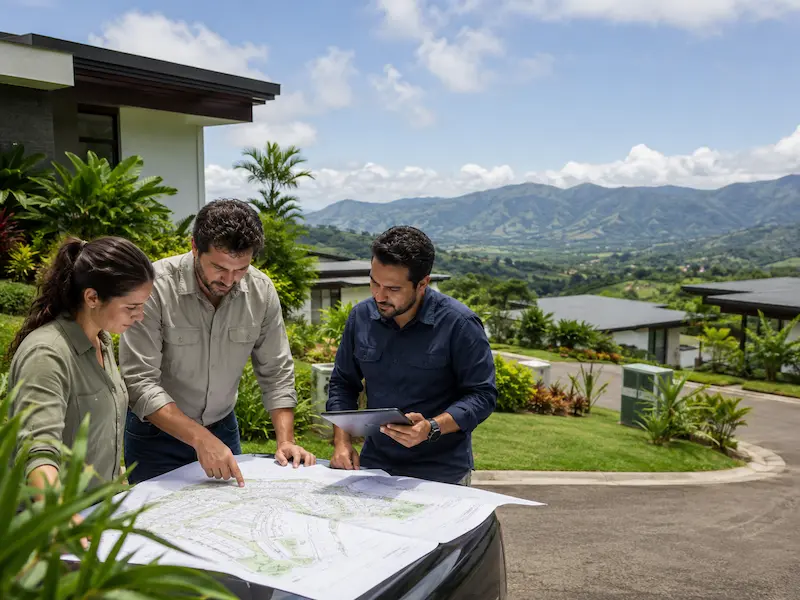
Before planning the investigation, we review what will be built, where the project is located, the proposed sanitation approach and what institutional information is already available.
- Property location and size.
- Site plan and number of residential units.
- Availability of drinking water and sanitation services.
- Status of the public sanitary sewer network.
- Available hydrogeological mapping.
- Nearby wells, springs and water bodies.
- Previous studies and institutional requirements.
This information helps determine whether proceeding with the specific studies required for the application is justified.
Which Studies Are Required for the Exemption?
The current procedure brings together three components that must be evaluated consistently: hydrogeology, contaminant transport and infiltration.
Hydrogeological Study
Examines geology, aquifer units, groundwater depth, flow direction and the project's relationship to nearby water sources.
Contaminant Transport Assessment
Examines potential contaminant pathways and travel times from subsurface effluent disposal to sensitive receptors.
Infiltration Tests
Measure soil infiltration behavior at the proposed locations for disposing of treated effluent.
None of these components should be interpreted in isolation. Good infiltration, for example, does not by itself prove that the system is hydrogeologically suitable.
The Hydrogeological Study Explains How the Subsurface Works
Before evaluating possible contaminant transport, we need to understand the geological units present, where groundwater occurs and the direction in which it moves.
Geo Costa Rica integrates geological, hydrogeological, mapping and field information to develop a conceptual model of the local system.
- Geology and subsurface materials.
- Hydrogeological units and aquifers.
- Depth to groundwater.
- Groundwater flow direction.
- Thickness of the unsaturated zone.
- Nearby wells and springs.
- Connections with streams, rivers and other receptors.
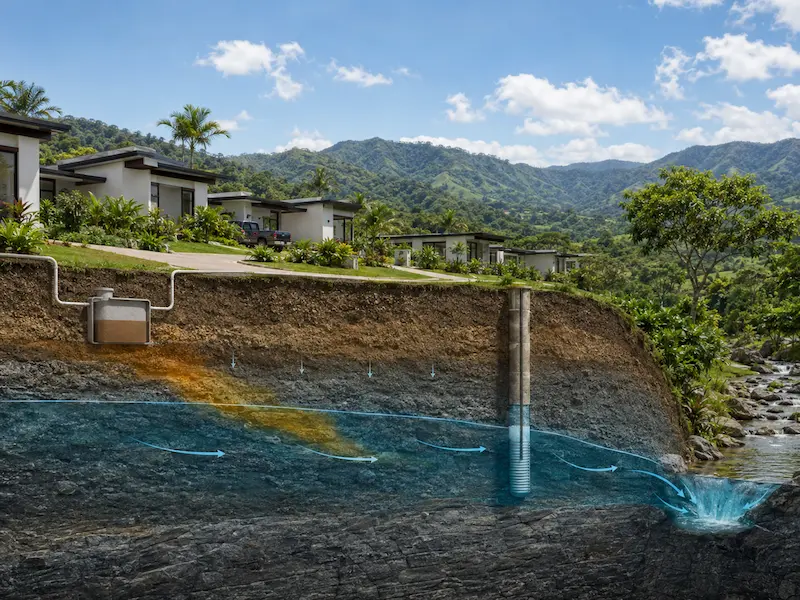
The hydrogeological model provides the basis for determining the potential pathways of contaminants and which receptors may lie along those pathways.
What Does a Contaminant Transport Assessment Examine?
It assesses how a contaminant could move from the subsurface disposal system toward groundwater, a water supply intake or a water body.
Where Would It Travel?
The analysis considers flow direction and hydrogeological connectivity between the disposal area and potential receptors.
How Long Could It Take?
Transport conditions within the unsaturated zone and aquifer are estimated based on the hydrogeological model.
What Could Be Affected?
Wells, springs, water supply intakes, streams and other sensitive receptors must be considered when a potential connection exists.
Can the proposed disposal system operate without creating unacceptable risks to water resources?
The answer does not depend solely on horizontal distance. Geology, groundwater depth, subsurface properties, flow direction and contaminant behavior must also be considered.
Infiltration Testing for the Disposal System
These tests measure how water infiltrates at the proposed subsurface disposal locations and provide information needed to evaluate the wastewater management solution.
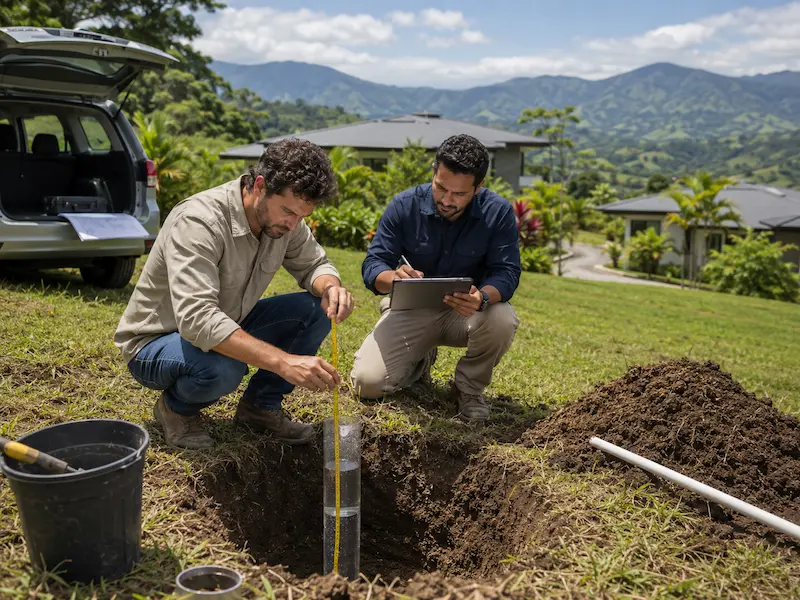
The current procedure requires a minimum of three infiltration tests per hectare within residential areas or areas proposed for subsurface disposal of treated effluent.
Test locations must adequately represent the areas where the system will operate and account for variations across the site.
- Representative selection of test locations.
- Documentation of soil conditions.
- Infiltration measurements.
- Coordinates and field documentation.
- Integration of findings with the hydrogeological study.
A favorable infiltration rate does not guarantee that an exemption will be granted. The results must be assessed together with aquifer conditions, groundwater depth and potential contaminant transport.
How Does Geo Costa Rica Prepare the Technical Application?
We bring together the project review, field investigation, hydrogeology, infiltration testing, contaminant transport and mapping in a single assessment.
What Are the Roles of AyA and SENARA in This Procedure?
The current regulatory amendment provides for interagency coordination after the study is submitted to AyA.
Prepares the Technical Documentation
- Hydrogeological study.
- Contaminant transport assessment.
- Infiltration testing.
- Mapping and documentation.
- Application management.
Receives and Reviews the Application
- Checks admissibility.
- Reviews requirements and studies.
- Develops technical findings.
- Coordinates with SENARA.
- Issues the administrative decision.
Participates in Technical Coordination
AyA forwards the relevant technical findings to SENARA for its response within the hydrogeological responsibilities applicable to the procedure.
This procedure should not be confused with obtaining a separate SENARA Technical Opinion beforehand. Under the amended procedure, the application and supporting technical studies are submitted to AyA, and interagency coordination takes place afterward.
What Do We Need to Review Your Project?
You do not need a complete application file for an initial technical review.
Property Information
- Cadastral survey plan.
- Property location.
- Approximate land area.
- Property registry number, if available.
Design and Characteristics
- Site plan.
- Number of housing units or condominium units.
- Proposed construction area.
- Proposed wastewater system, if already defined.
Institutional Background
- Service availability certificate.
- Information on existing sewer infrastructure.
- Official correspondence or requests for additional information.
- Previous technical studies.
How Does the Exemption Application Proceed?
Once studies and documentation have been prepared, the application enters an institutional review process that may include requests for clarification and technical coordination.
Institutional processing times do not necessarily include the time required to prepare studies, respond to requests or provide additional information during the procedure.
Questions About Sanitary Sewer Exemptions before AyA
Straightforward answers to common questions before commissioning studies.
What Is a Sanitary Sewer Exemption?
It is a procedure through which AyA may exempt certain residential developments from constructing the required sewer network and treatment plant, provided they meet regulatory requirements.
Does the Exemption Apply to Commercial Projects?
The current procedure requires wastewater discharge to be exclusively residential in origin.
Which Study Does AyA Require?
The application requires a Hydrogeological and Contaminant Transport Study consistent with the applicable technical scope, along with the corresponding infiltration tests.
How Many Infiltration Tests Are Required?
The current procedure requires at least three tests per hectare in residential areas or areas proposed for subsurface disposal of treated effluent.
If the Soil Infiltrates Well, Will AyA Approve the Exemption?
No. Infiltration is only one component. Hydrogeological conditions and potential contaminant transport must also be evaluated.
Do I Need a SENARA Technical Opinion First?
Under the current procedure, the study is submitted to AyA, which subsequently coordinates with SENARA as part of the institutional review.
What If There Are Wells or Springs Nearby?
They must be included in the hydrogeological assessment to evaluate their relationship to groundwater flow and possible contaminant pathways.
Does the Study Guarantee That AyA Will Grant the Exemption?
No. Geo Costa Rica prepares and technically supports the study. Only AyA can issue the decision.
AyA Requested Additional Information. Can Geo Costa Rica Review It?
Yes. We can evaluate the request and identify the information, correction or supplementary study needed within our technical scope.
What Should I Send to Request a Quote?
Ideally, provide the property survey plan, location, project design, number of residential units, service availability and any official correspondence or requirements received.
Related Studies and Procedures
Depending on the project, additional technical studies, water supply conditions or institutional procedures may be involved.
Hydrogeological Study
Characterization of aquifers, water levels, groundwater flow and the property's hydrogeological conditions.
Contaminant Transport
Assessment of possible transport pathways and travel times from a contamination source to an aquifer, wells or other sensitive receptors.
Drinking Water and Sewerage Service Availability
Assistance with the Service Availability Certificate for projects served by AyA, considering drinking water, sanitation and project characteristics.
Want to Know Whether Your Project Could Qualify for an Exemption?
We can first review the project, service availability and property background before defining the scope of hydrogeological studies.
Send us the location, property survey plan, available design and any documents received from AyA.