


Archaeological Salvage for Development Projects in Costa Rica
We carry out archaeological salvage when a prior assessment identifies areas requiring controlled recovery, documentation and specialized management before project activities disturb them.
Archaeological salvage recovers information before project activities disturb an area
Archaeological salvage is a specialized intervention in which archaeological evidence in areas affected by construction or other activities is recovered and documented under controlled conditions.
Controlled recovery
Archaeological information is recovered through planned activities following defined methods and technical documentation procedures.
Previously identified areas
Usually applied to areas identified during an earlier Archaeological Assessment.
Technical documentation
The process produces spatial records, stratigraphic descriptions, material inventories and final documentation of the salvage operation.
When might archaeological salvage be required?
Salvage may be required when a previous investigation determines that part of a project will affect archaeological evidence that must be recovered and documented before intervention.
Archaeological Assessment findings
When an assessment identifies areas that cannot be cleared without further intervention.
Direct disturbance of the site
When construction, excavation or infrastructure will affect an area containing archaeological evidence.
Need to recover information
When the scientific value of archaeological context requires documentation and recovery before an area is disturbed.
Coordination with the project schedule
When early integration of archaeological activities into the project schedule is beneficial.
Salvage generally follows a prior archaeological assessment
An assessment identifies, delineates and interprets evidence. Its findings help determine which areas can be cleared and which require archaeological salvage.
Archaeological Assessment
Investigates the site in greater detail to characterize the distribution and condition of archaeological evidence.
Archaeological Salvage
Recovers and documents evidence in designated areas before construction activities disturb them.
Archaeological salvage requires technical planning and institutional coordination
Before archaeological salvage begins, its scope, methods, affected areas and working conditions must be defined in accordance with the applicable institutional framework.
Review background information
We review the archaeological assessment and the project that prompted the salvage.
Define the scope
We establish areas, objectives, methods and fieldwork requirements.
Prepare the proposal
A technical proposal is prepared in accordance with the relevant procedure.
Coordinate authorizations
Applicable institutional steps are addressed before work begins.
Carry out salvage
Recovery and documentation activities are undertaken in the field.
Document and close
Findings, recovered materials and final documentation are consolidated.
Recovery involves controlled archaeological excavation and recording
Salvage is not an improvised excavation. It requires controlled digging, stratigraphic observation, documentation of features, positioning of finds and systematic contextual recording.
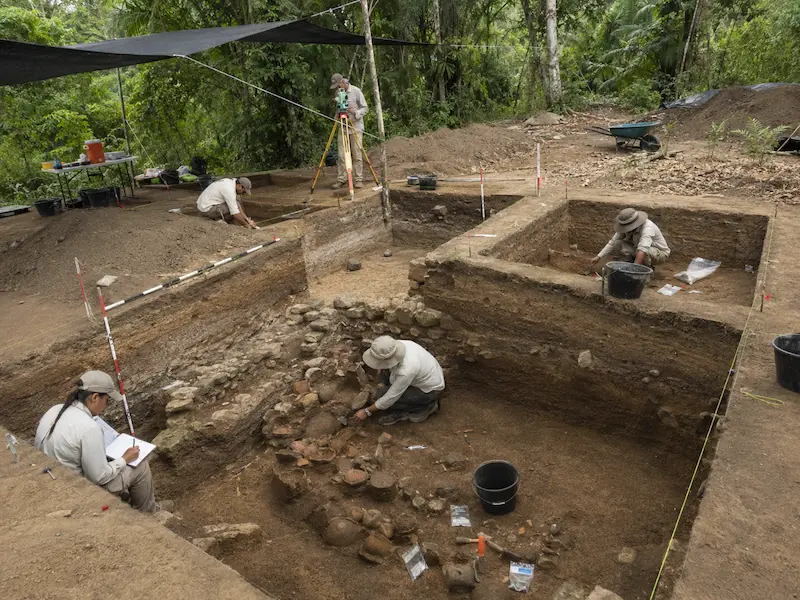
Aspects that may be recorded during salvage
- Excavation units and their locations.
- Stratigraphy and exposed profiles.
- Features or concentrations of materials.
- Spatial relationships between identified elements.
- Recovered archaeological materials.
- Photographs, sketches and field observations.
- Conditions relevant to interpreting the site.
Mapping helps define what needs to be salvaged and where activities take place
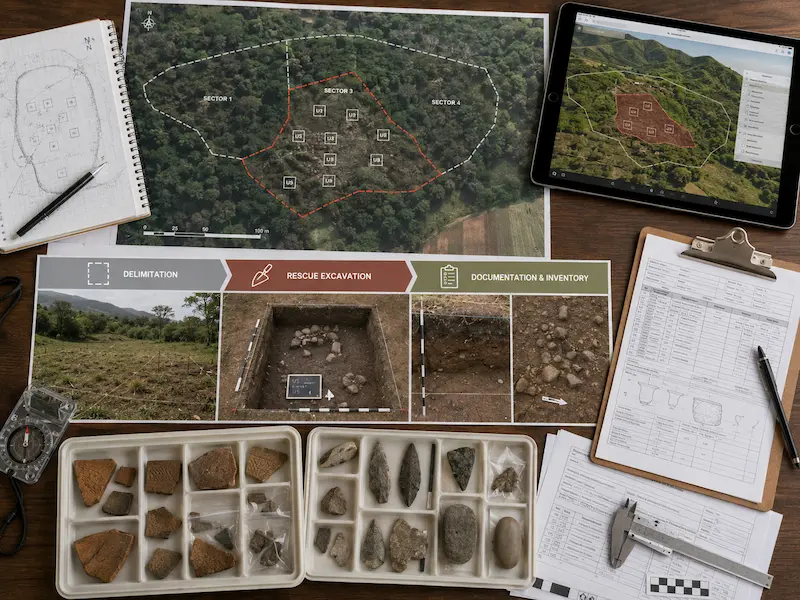
Spatial information is essential for relating the project area, areas requiring salvage, cleared areas and archaeological units excavated during the process.
Spatial elements that can be incorporated
- Full project area.
- Areas designated for salvage.
- Cleared areas or areas not subject to intervention.
- Locations of excavation units.
- Photographic documentation points.
- Distribution of finds and materials.
- Relationship to planned infrastructure.
The value of archaeological salvage also depends on the quality of its documentation
The process must produce a solid technical record to describe excavated contexts, support interpretations and organize recovered materials.
Excavation-unit records
Field logs, sketches and activity tracking by unit or area.
Photographs
Visual documentation of contexts, finds, profiles and procedures.
Recovered materials
Organization and identification of recovered objects and evidence.
Technical report
Integration of findings, interpretation and final documentation of salvage.
Archaeological salvage is conducted under specialized procedures
Protecting archaeological heritage in Costa Rica involves the National Archaeological Commission (Comisión Arqueológica Nacional) and the National Museum of Costa Rica (Museo Nacional de Costa Rica), as well as environmental procedures where applicable.
National Museum of Costa Rica and National Archaeological Commission
Archaeological salvage is a technical intervention within the institutional framework for heritage protection, including the coordination, oversight and documentation appropriate to each case.
When a project also undergoes environmental permitting, archaeological work may be linked to its SETENA file and applicable conditions.
National Archaeological Commission
Participates in archaeological procedures and the applicable approval and oversight framework.
Relationship to environmental assessment
For some projects, salvage requirements may arise from studies or conditions associated with environmental assessment.
An unexpected discovery during construction is not handled as routine salvage
If previously unknown remains are found during excavation or earthworks, the area must be protected and the situation addressed through the applicable institutional procedure.
Protect the area
Prevent further disturbance of the location or area where evidence was found.
Record the conditions
Document the location, photographs and general circumstances of the discovery.
Coordinate next steps
Identify the appropriate professional and institutional procedure.
Including salvage in the project schedule supports better decisions
When salvage is considered early in project development, it is easier to organize activities, budgets, access, fieldwork periods and coordination among disciplines.
From preliminary studies to final salvage documentation
We review background information
We assess the archaeological evaluation, location, project design and affected areas.
We define the scope
We delineate the areas, fieldwork needs and overall salvage strategy.
We prepare the proposal
We organize the technical and documentary basis required for the procedure.
We carry out fieldwork
We undertake excavation, recording, recovery and control of archaeological context.
We organize the findings
We integrate spatial information, photographs, inventories and technical observations.
We close the process
We consolidate final documentation according to the scope of work undertaken.
A documented, technically structured archaeological salvage process
Salvage is part of a broader preventive archaeology process
Rapid Archaeological Assessment
Initial site review to identify visible evidence and determine whether further investigation may be needed.
Archaeological Assessment
More detailed investigation to delineate and interpret archaeological evidence.
Archaeological Monitoring
Monitoring of earthworks to observe and document archaeological conditions during construction.
Before starting archaeological salvage
Does every project involving archaeology require salvage?
No. The need for salvage depends on the findings of the archaeological assessment and the expected impact of the project.
Is salvage carried out across the entire property?
Not necessarily. It usually focuses on areas identified as significant and affected by the planned activities.
What is the difference between assessment and salvage?
Assessment investigates and delineates evidence. Salvage recovers and documents evidence within previously identified areas.
What happens if construction has begun and unexpected evidence is found?
The area should be protected, its conditions documented and the relevant institutional procedure for unexpected discoveries followed.
What does Geo Costa Rica need to evaluate the case?
The project location, plans, a description of the works and, if possible, an archaeological assessment or any available background information.
Can this be related to a SETENA procedure?
Yes, when archaeological work forms part of the environmental file or the studies associated with the project.
Does your project require archaeological salvage in a designated area?
We can review the prior assessment, affected area and project scope to structure archaeological work and coordinate the corresponding technical process.
Let us coordinate the process
Send us the project location, plans, previous archaeological assessment and a description of the works that will affect the area.