



Archaeological Monitoring of Earthworks
We accompany excavations and earthworks to observe, document and promptly address archaeological conditions that may arise during project execution.
Integrating archaeology into actual construction earthworks
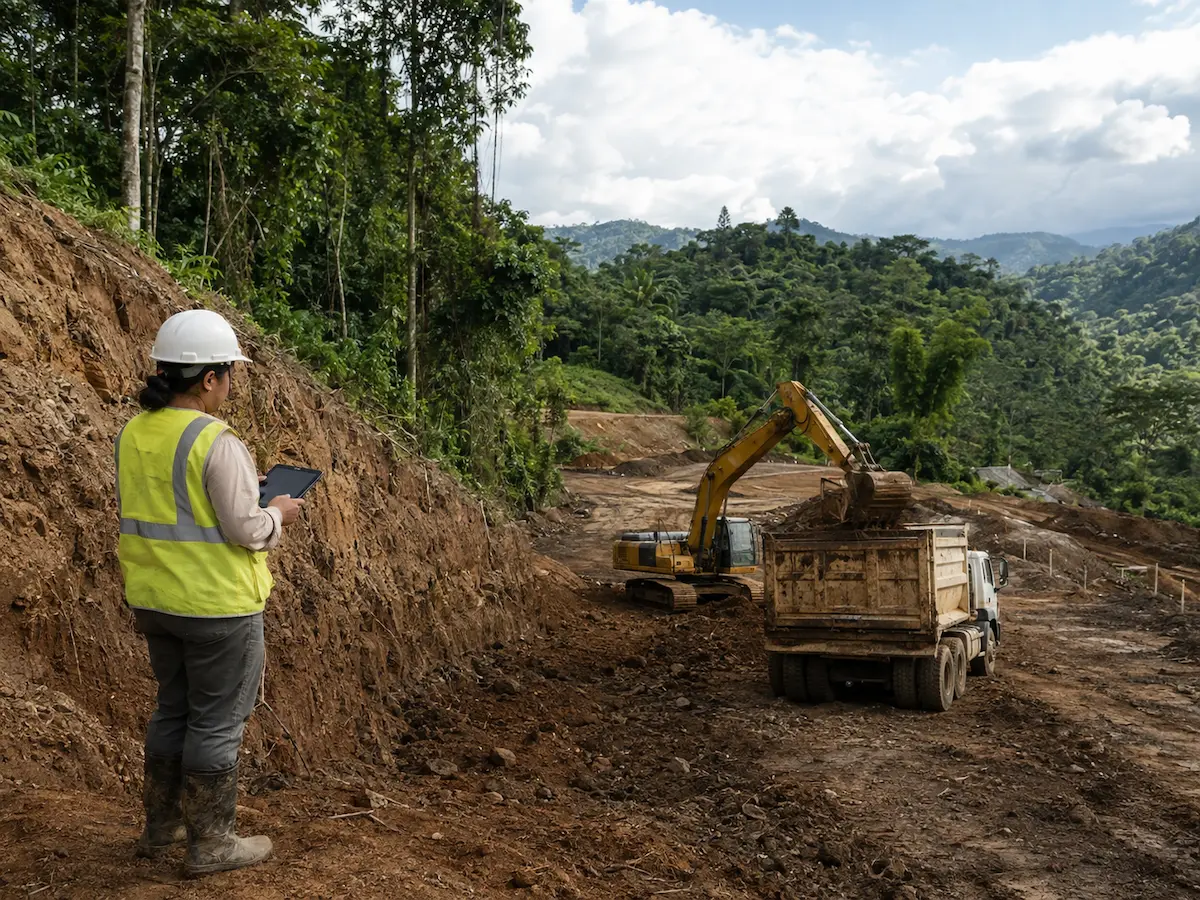
Archaeological Monitoring involves accompanying specified excavations, cuts, trenches or other earthworks to examine exposed surfaces and promptly identify archaeological evidence requiring attention.
Monitoring during ground disturbance
The specialist accompanies designated earthworks to observe conditions as they become exposed.
Documenting observations
Activities, areas, photographs, observations and any relevant archaeological conditions are recorded.
Early identification
Professional presence makes it possible to recognize evidence during ground disturbance and apply the appropriate procedures promptly.
When may Archaeological Monitoring be required?
Monitoring may be established based on an archaeological assessment, professional recommendations, institutional requirements, or the specific conditions of the site and proposed works.
Archaeological recommendation
When a previous study determines that certain earthworks must be carried out under professional monitoring.
Specific areas
When background information or prior findings justify observation during ground disturbance in particular areas.
Excavations and cuts
When construction exposes soil layers that could not be observed during a surface inspection.
Project commitments
When archaeological monitoring is part of the measures or conditions applicable during construction.
Investigating before construction is not the same as monitoring during construction
Archaeological Assessment
More detailed investigation to characterize and delineate previously identified archaeological conditions.
Archaeological Monitoring
Observes conditions exposed as earthworks advance and documents findings during construction.
Monitoring focuses on relevant ground disturbance
Depending on the scope established for the project, monitoring may accompany different activities that remove, cut or expose the subsurface.
The archaeologist must coordinate with actual construction progress
Effective monitoring requires knowing which areas will be disturbed, when earthworks will take place, and which activities need professional attendance.
We focus monitoring where it is actually needed
- Review of the earthworks schedule.
- Identification of areas requiring monitoring.
- Coordination with site managers.
- Scheduling monitoring visits.
- Monitoring active work fronts.
- Communication when relevant conditions arise.
- Recording the areas actually observed.
Monitoring also means demonstrating what was observed and where
Each field visit may generate records that make it possible to reconstruct which areas were disturbed, which activities were observed and which conditions were identified.
Monitoring log
Record of dates, affected areas, activities performed and relevant archaeological observations.
Photographic record
Visual documentation of cuts, excavations, observed conditions and monitored areas.
Spatial reference
Location of observed areas and any features that need to be included in monitoring records.
What happens if archaeological evidence is found during construction?
Identifying evidence during earthworks requires documenting the discovery and applying the relevant archaeological measures and procedures before work continues in the affected area.
Identify
The specialist recognizes a condition that may be of archaeological interest.
Protect the area
Further direct disturbance of the area is avoided while the appropriate next steps are determined.
Document
Record the location, context and observed conditions.
Assess
The specialist determines the nature of the observed condition and its implications.
Coordinate
Carry out the applicable communications and institutional procedures.
Determine next steps
Work in the area resumes in accordance with the applicable procedures and instructions.
Knowing which areas were disturbed is also part of monitoring
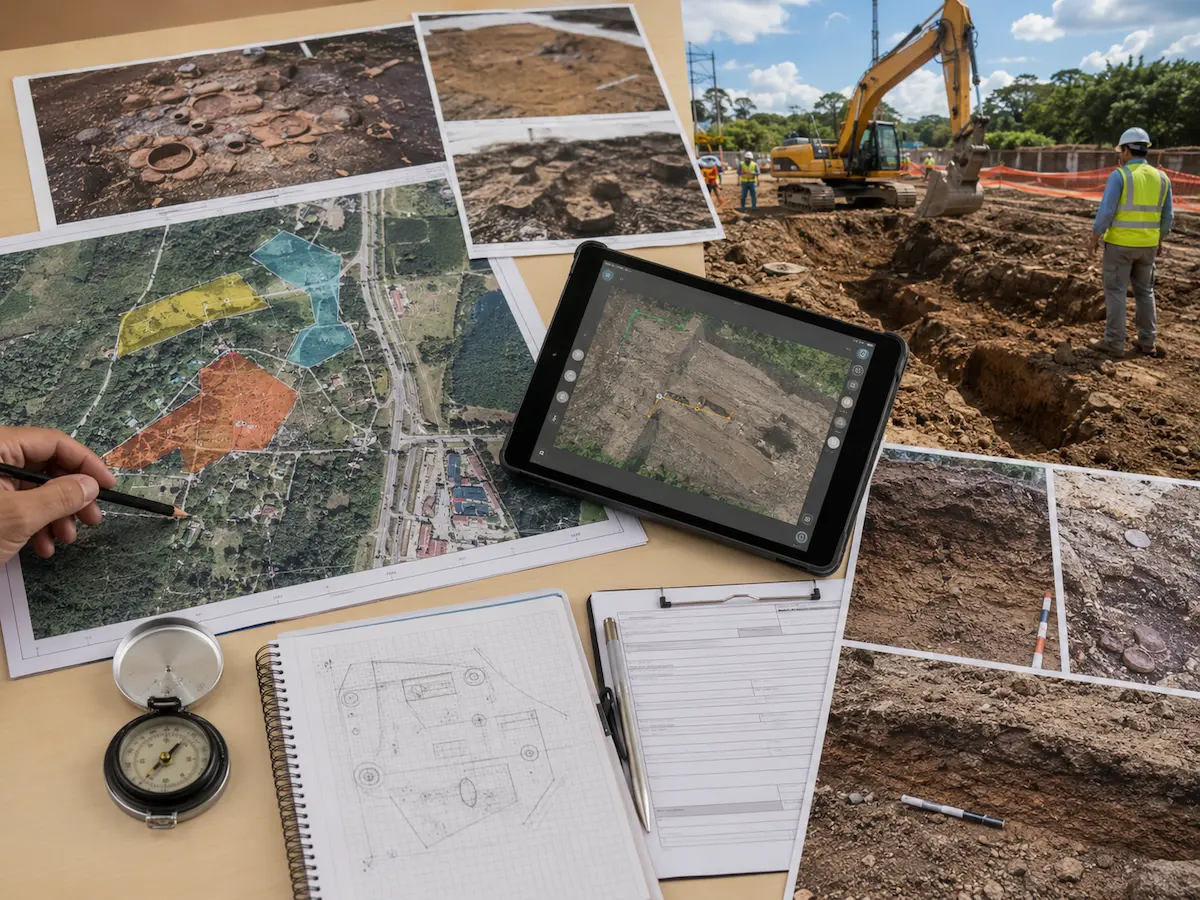
For large projects or projects with multiple work fronts, mapping helps relate construction progress to the areas requiring archaeological monitoring.
From the construction schedule to the monitoring map
- Project area.
- Areas requiring monitoring.
- Active earthwork fronts.
- Areas already disturbed.
- Monitoring visits completed.
- Photo locations.
- Relevant observations.
- Location of evidence, where applicable.
Archaeological monitoring operates within a specialized institutional framework
Protecting archaeological heritage in Costa Rica involves specific responsibilities of the National Archaeological Commission and the National Museum of Costa Rica, and may also be related to environmental procedures before SETENA.

National Museum of Costa Rica and National Archaeological Commission
Archaeological investigations and actions are carried out under the framework established to protect, regulate and monitor Costa Rica's archaeological heritage.
When an archaeological condition requiring further action is identified during construction, the relevant professional and institutional procedures must be followed.
National Archaeological Commission
Participates in professional accreditation and procedures applicable to authorized archaeological investigations.
SETENA
Monitoring may be part of commitments, recommendations or measures linked to a project's environmental assessment process.
We coordinate monitoring with actual construction phases
Review background information
Examine previous studies, recommendations and areas requiring monitoring.
Review construction works
Identify planned activities, work fronts and earthworks.
Schedule site visits
Plan professional attendance according to construction progress.
Conduct monitoring
Observe earthworks and the conditions exposed by ground disturbance.
Document findings
Record activities, photographs, areas and relevant observations.
Report results
Compile the monitoring performed and provide appropriate recommendations.
Documented monitoring of archaeologically relevant ground disturbance
Monitoring is part of a broader preventive archaeology process
Rapid Archaeological Report
Initial site assessment to identify visible archaeological evidence and determine whether further investigation is needed.
Archaeological Assessment
More detailed investigation to delineate, characterize and interpret archaeological evidence.
Archaeological Salvage
Specialized procedure when archaeological conditions require additional intervention before certain project activities can continue, subject to the applicable institutional authorizations.
Before starting Archaeological Monitoring
Are Archaeological Monitoring and Archaeological Assessment the same?
No. Assessment investigates and characterizes archaeological conditions before certain interventions. Monitoring accompanies earthworks during construction.
Must the archaeologist be present throughout construction?
Not necessarily. The scope depends on the areas, activities and conditions requiring archaeological monitoring.
Which activities typically require monitoring?
These may include excavations, cuts, trenches, platforms, foundations and other activities that expose the subsurface, according to the scope defined for the project.
What happens if archaeological material is discovered?
The specialist documents the discovery and the relevant measures and procedures are applied before disturbance resumes in the affected area.
Does monitoring necessarily lead to archaeological salvage?
No. Monitoring may conclude without finding evidence that requires further action. Each situation must be assessed based on the conditions observed.
What does Geo Costa Rica need to provide a monitoring quote?
We can start with the project location, plans, a preliminary earthworks schedule and any available previous archaeological report or assessment.
Does your project require archaeological monitoring during earthworks?
We can review archaeological background information, areas requiring monitoring and the construction schedule to organize monitoring of relevant ground-disturbing activities.
Let's coordinate the monitoring
Send us the project location, plans, archaeological background information and a description of the planned earthworks.