



Well Interference Assessment: Wells and Surface Water Bodies
Geo Costa Rica conducts interference assessments to examine how pumping-induced drawdown propagates through an aquifer and determine whether groundwater extraction could affect neighboring wells, springs, streams, rivers or other nearby water bodies.
Determine whether pumping from one well may affect a nearby receptor
When groundwater is pumped from a well, it can generate a cone of depression that changes water levels in the aquifer. An interference assessment evaluates whether these changes may reach another well or a nearby surface water body.
Could pumping from this well adversely affect another well or a surface water body?
The purpose is not merely to calculate a theoretical radius, but to assess how drawdown propagates and evaluate its potential effect on a specific receptor.
Depending on the case, the report may consider distance, pumping rate, operating regime, hydraulic parameters and the hydrogeological relationship between the pumping well and the receptor.
At Geo Costa Rica, the assessment focuses on the relationship between the pumping well, the aquifer and the potential receptor—not simply on an isolated distance value.
Interference between a pumping well and a receptor well
When two wells are relatively close, pumping from one may lower the water level in the other. The assessment seeks to estimate this effect under specified operating conditions.
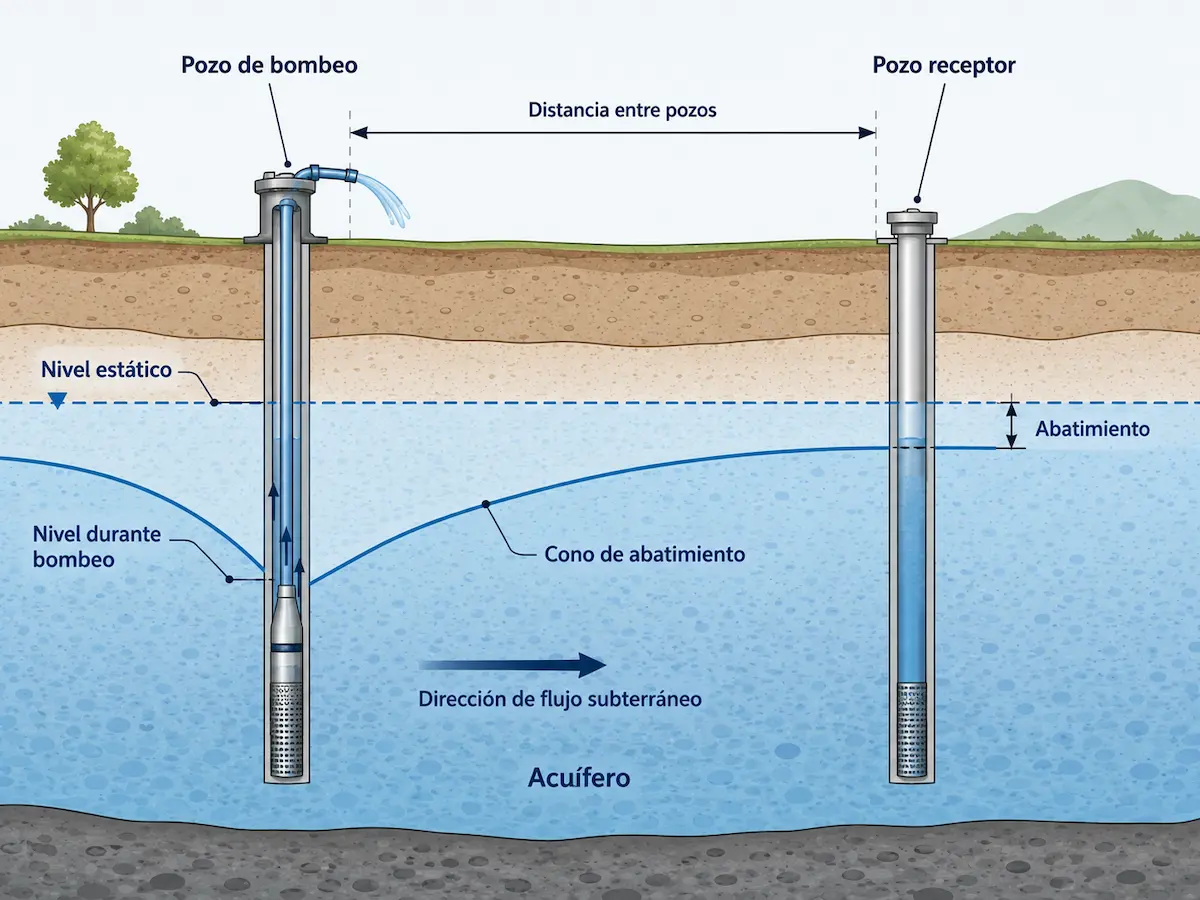
Pumping-induced drawdown can propagate through an aquifer
The assessment considers the pumping well, the receptor well, the distance between them, static and pumping water levels, and the manner in which the aquifer transmits the effect.
Interference between a well and a surface water body
When a well is near a stream, river, creek or spring, the study examines whether pumping may alter the relationship between the aquifer and that water body.
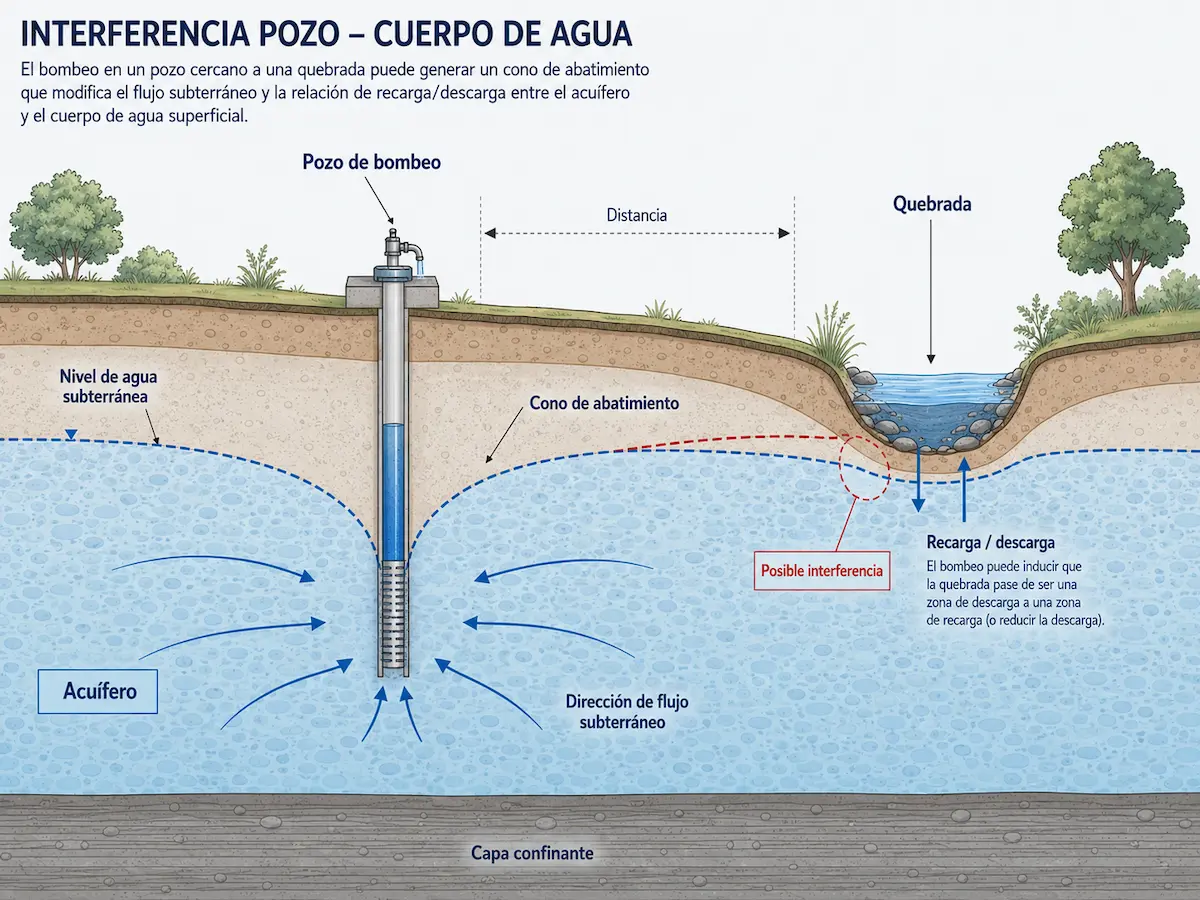
Distance alone is not enough: hydrogeological connectivity must be assessed
An important part of this study is understanding whether the aquifer and surface water body are hydraulically connected, and how pumping might alter discharge, induced recharge or the local groundwater gradient.
Assess drawdown in relation to the aquifer, receptor and pumping regime
The study scope depends on the specific case and available information, but normally combines well records, aquifer characteristics and the conditions of the receptor under assessment.
Relevant hydrogeological information
- Location and characteristics of the pumping well.
- Proposed pumping rate and operating regime.
- Distance to the receptor well or water body.
- Aquifer type and groundwater flow conditions.
- Available or technically justifiable hydraulic parameters.
- Water levels and information on nearby wells.
A technical conclusion regarding potential interference
- Interpretation of local hydrogeological conditions.
- Estimated drawdown at the receptor under assessment.
- Evaluation of potential hydraulic interference.
- Assessment scenarios based on pumping rate or duration.
- Technical conclusions regarding the assessed conditions.
- Supporting documentation where the study is required for a regulatory procedure.
This assessment is not the same as a Pumping Test or a reduction of the ROP
A Pumping Test evaluates the hydraulic response of a well. An interference assessment uses hydrogeological information to analyze possible effects on a nearby receptor. A reduction of the Operational Protection Radius (ROP) addresses a different technical question.
When might a Well Interference Assessment be needed?
This study may be used when a planned or existing groundwater well is close to other wells or surface water bodies and potential impacts need to be assessed technically.
Whether the study is required depends on the case and applicable regulations
For certain water well procedures, proximity to third-party wells or water bodies may require an interference and drawdown assessment. The study scope must be reviewed against site conditions and the requirements currently applicable to the specific case.
Common questions about interference between wells and water bodies
What exactly is well interference?
It is the potential effect of pumping from one well on another, caused by the propagation of drawdown through the aquifer.
How can a well affect a stream or river?
Where the aquifer and surface water body are hydraulically connected, pumping may change the groundwater gradient and alter local discharge or recharge conditions.
Is this the same as a Pumping Test?
No. A Pumping Test measures the hydraulic response of a well. An interference assessment uses hydrogeological information to evaluate possible effects on another nearby receptor.
Can this study be required for a regulatory procedure?
Yes. Certain groundwater-use procedures may require a technical interference and drawdown assessment, depending on the case and applicable regulatory framework.
Technically assess potential interference from your well
Geo Costa Rica prepares well and surface water interference assessments to evaluate drawdown, pumping conditions and possible effects on nearby receptors in Costa Rica.