



Hydraulic Study of Watercourses and Structures
We analyze how water flow behaves in streams, channels, culverts, bridges and other structures to assess water levels, velocities, hydraulic capacity and the effects of interventions on flow.
Hydraulics helps explain what happens when water flows through a watercourse or structure
A hydraulic study starts with a specified flow rate and examines how the system conveying the water responds. Its purpose is to understand flow conditions and determine whether the watercourse or structure has adequate capacity under the scenario assessed.
While a Hydrological Study estimates the flow that a watershed may generate, hydraulic analysis examines what happens when that flow reaches a particular channel cross-section, culvert, bridge, canal or other structure.
The geometry available to convey water directly influences water level, flow velocity and system capacity. The same flow rate can therefore produce different responses along different reaches of a watercourse.
- Analyzes water levels or flow depths.
- Helps estimate flow velocities.
- Assesses the hydraulic capacity of a watercourse or structure.
- Enables comparison of different conditions or scenarios.
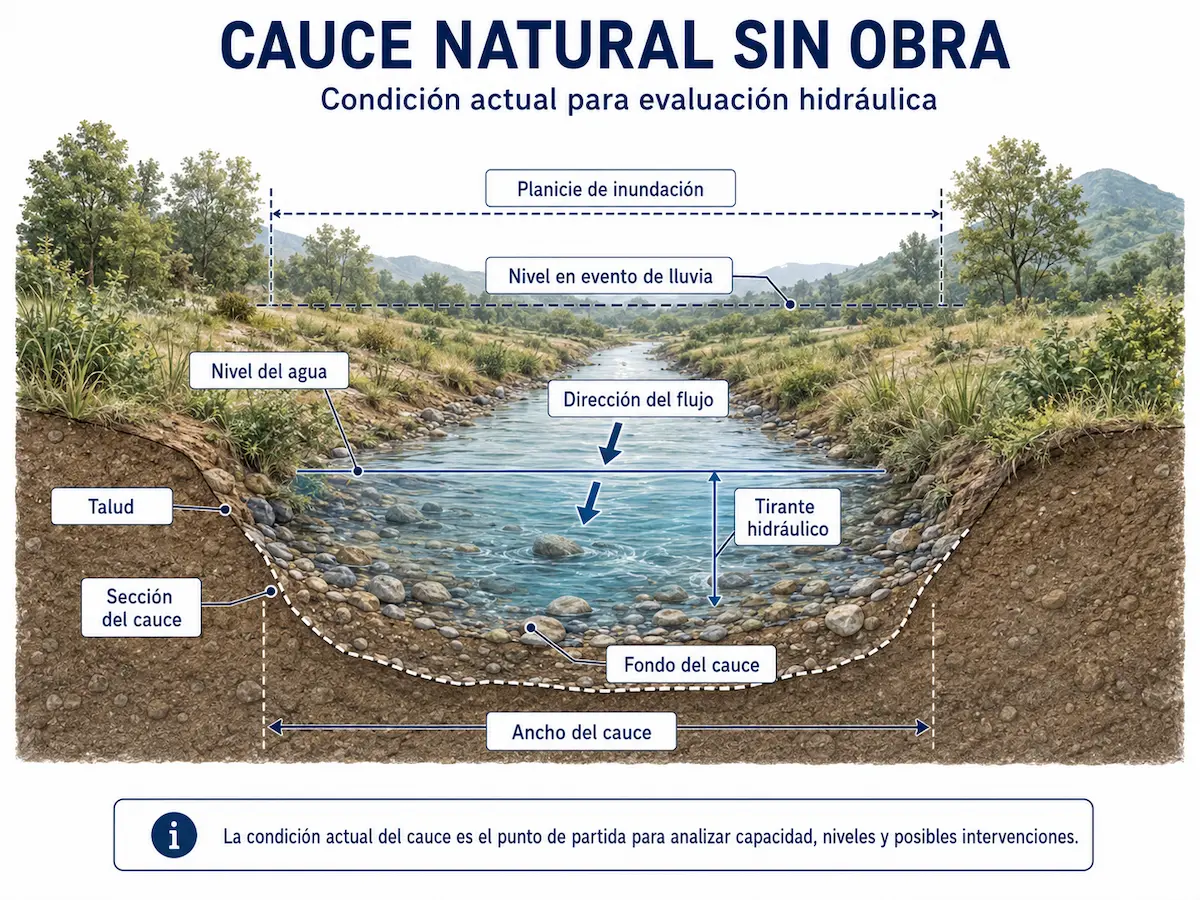
Flow rate is the starting point; hydraulics determines what happens when that flow reaches the watercourse or structure that must convey it.
The same flow rate does not behave identically in every watercourse or pass through every structure in the same way
Hydraulic response depends on the physical characteristics of the channel, slope, flow resistance and structures that locally change the cross-sectional area available for water to pass through.
Upstream and downstream conditions can also matter
Hydraulic behavior at a given location may depend on downstream water levels, changes in slope, nearby structures, confluences or other system conditions.
We combine flow rate, geometry and hydraulic conditions to represent flow behavior
The method is selected according to the watercourse or structure, available information and the question to be answered. Not every project requires the same level of modeling.
Define flow rate and geometry
We incorporate the flow rate to be assessed and characterize the watercourse or structure using topography, dimensions, profiles and cross-sections according to the project scope.
Develop the hydraulic analysis
We integrate gradient, roughness, structures and system conditions to represent how water moves under the defined scenario or scenarios.
Interpret the results
We analyze water levels, velocities, flow depths and hydraulic capacity to identify expected behavior and assess the technical implications for the project.
Modeling is a tool for representing the system. The principal outcome of the study is the technical interpretation of its hydraulic behavior.
A structure may locally alter flow conditions
Culverts, bridges, water crossings, channelization and other interventions can change the available cross-section and cause changes in water levels and velocities. The study makes it possible to assess these conditions before decisions are made about the structure.
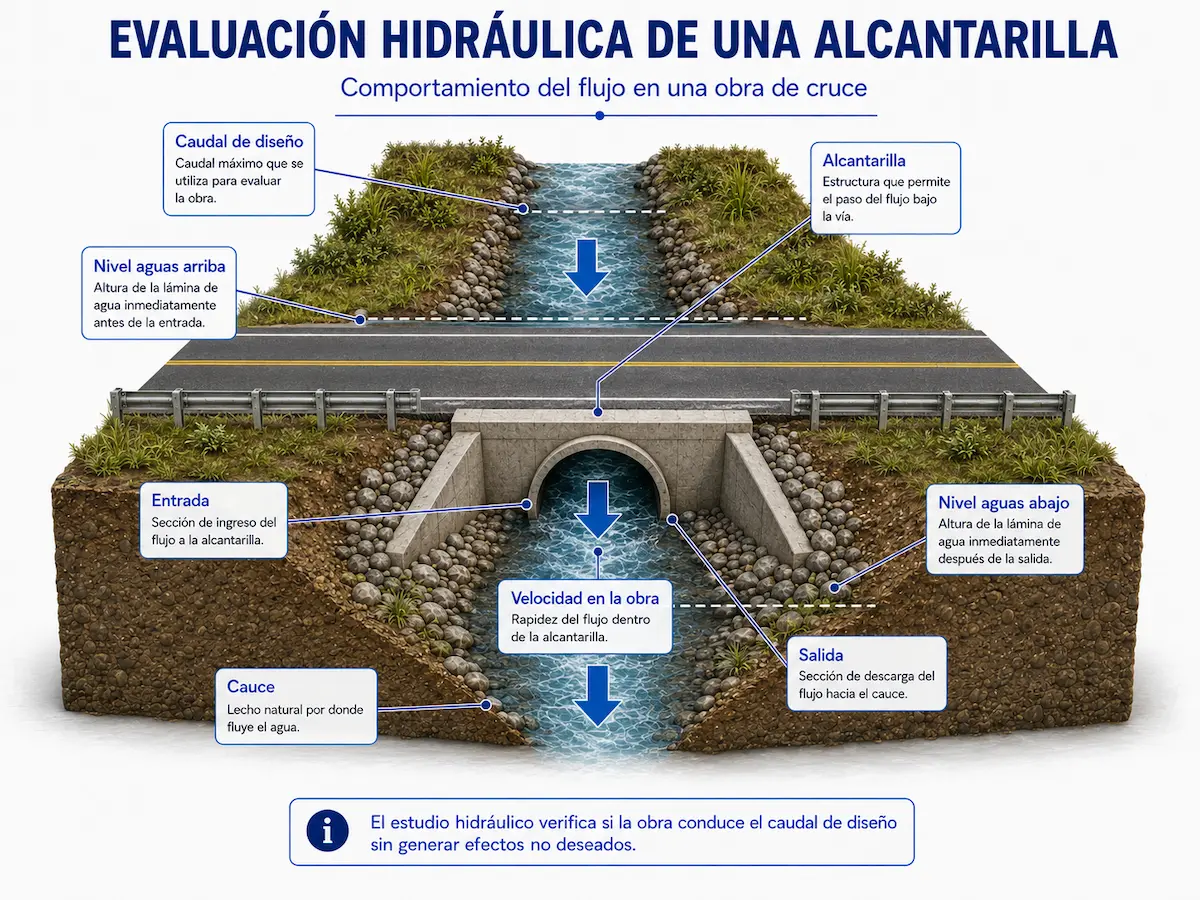
Knowing a structure’s dimensions is not enough
The capacity of a structure depends on the relationship between flow rate, geometry, upstream water level, outlet conditions and flow behavior.
Hydraulic analysis should therefore examine the structure within its broader context rather than in isolation.
The objective is not to assume that a structure causes an impact, but to determine how it changes flow under the conditions assessed and evaluate its behavior from a technical standpoint.
Useful information for assessing watercourses, structures and flow conditions
The final contents depend on the project objectives, but the study aims to produce interpretable results that can directly inform planning, assessment or design decisions.
What might the report include?
- Characterization of the watercourse or structure.
- Cross-sections and longitudinal profiles.
- Water levels or flow depths.
- Flow velocities.
- Hydraulic capacity of structures.
- Assessment of bridges, culverts, channels or other structures.
- Comparison of existing and proposed conditions.
- Technical calculations, criteria, conclusions and recommendations.
When might it be needed?
- Bridges and culverts.
- Water crossings and stream crossings.
- Channels and drainage works.
- Changes or interventions in watercourses.
- Residential subdivisions and real estate developments.
- Road infrastructure and access routes.
- Environmental assessments.
- Technical support for specific institutional procedures.
Not every project needs the same level of analysis
A single culvert, a bridge, a channel modification or a larger system may require different levels of data and modeling. The scope should address the actual problem to be resolved.
Hydrology, hydraulics and flood hazard assessment answer different questions
These reports may be related within a single project, but each examines a different aspect of the water system.
Hydrological Study
Examines how rainfall becomes runoff and helps estimate the flow rate to be considered for a project.
View Hydrological StudyFlood Hazard Assessment
Assesses the potential spatial extent of water and the areas that could be affected under specified scenarios.
View Flood Hazard AssessmentStream and Spring Flow Measurement
Measures the flow at a specific location and can provide field data when required by the study objectives.
View Stream and Spring Flow MeasurementPut simply: hydrology determines how much flow arrives; hydraulics examines how that flow behaves; and flood hazard assessment identifies where flooding may affect the surrounding area.
Frequently asked questions about hydraulic studies
Several distinctions are important when deciding which type of analysis a project requires.
Is this the same as a Hydrological Study?
No. A Hydrological Study estimates watershed response and associated flow rates. A Hydraulic Study examines how those flows behave within a watercourse or structure.
Is it the same as a Flood Hazard Assessment?
No. Hydraulic analysis can provide water levels and velocities, while a Flood Hazard Assessment focuses on identifying which areas could be affected by water.
Is hydraulic modeling always required?
It depends on the objective, the complexity of the system and the available information. The level of analysis should be proportional to the problem being addressed.
Does the study include the full structural design of the works?
Not necessarily. The hydraulic study assesses flow behavior and can inform the design of a structure, but structural drawings, foundations, construction details and other engineering components depend on the specific project scope.
Do you need to assess flow behavior in a watercourse or structure?
Geo Costa Rica develops hydraulic studies tailored to the project type, the flow rate to be analyzed and the actual characteristics of the watercourse, channel or structure under assessment.
We can review your case and determine what information, surveys and level of analysis are needed to answer the project’s technical question.