



Archaeological Assessment for Projects in Costa Rica
We investigate, delineate and interpret archaeological evidence identified on a property to understand its distribution, characteristics and relationship to the proposed works.
Gain a deeper understanding of the evidence identified
An Archaeological Assessment is a more detailed investigation to characterize an area where archaeological evidence, previous findings or site conditions call for further analysis before certain project activities proceed.
Where is the evidence located?
We investigate its location and distribution across the property using an archaeological methodology designed for the study.
What are its characteristics?
We document materials, stratigraphy, associations and other evidence needed to interpret site conditions.
How does it relate to the proposed works?
We compare the archaeological findings with the location, scope and proposed infrastructure components.
When might an Archaeological Assessment be necessary?
An assessment may be needed when an initial inspection, archaeological background or project-specific conditions indicate that more detailed investigation is required.
Evidence identified
When a Rapid Archaeological Report identifies materials or conditions requiring further examination.
Archaeological context
When existing archaeological records justify closer investigation of specific parts of the property.
Earthworks
When planned works could affect areas containing archaeological evidence or sensitivity.
Defining measures
When sufficient information is needed to establish recommendations or subsequent actions.
A Rapid Archaeological Report and an Assessment answer different questions
Rapid Archaeological Report
Provides an initial site review to identify visible evidence and determine whether conditions warrant further investigation.
Archaeological Assessment
Uses an authorized methodology to further delineate, characterize and interpret the identified archaeological evidence.
The assessment requires planning and prior authorization
A formal Archaeological Assessment must follow a research proposal prepared by the responsible professional and the applicable institutional procedure.
The methodology is defined before fieldwork begins
Controlled investigation of archaeological evidence
Fieldwork follows the authorized methodology and seeks information about the distribution, depth, characteristics and context of archaeological evidence.
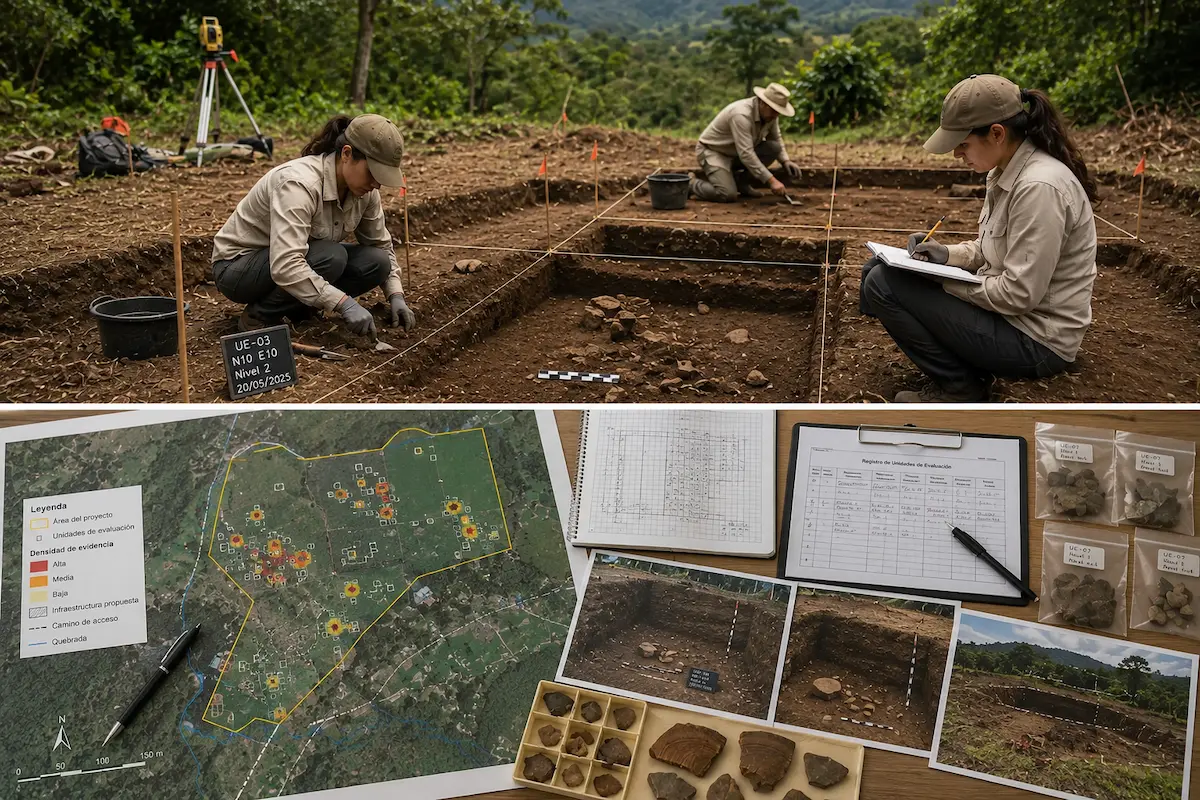
The method depends on the assessment questions
- Systematic survey and reconnaissance.
- Assessment units or test excavations, where applicable.
- Recording stratigraphy and depth.
- Documenting archaeological materials.
- Photographic and descriptive records.
- Geographic location of assessment units and evidence.
- Recording material provenance and context.
- Integrating results according to the approved methodology.
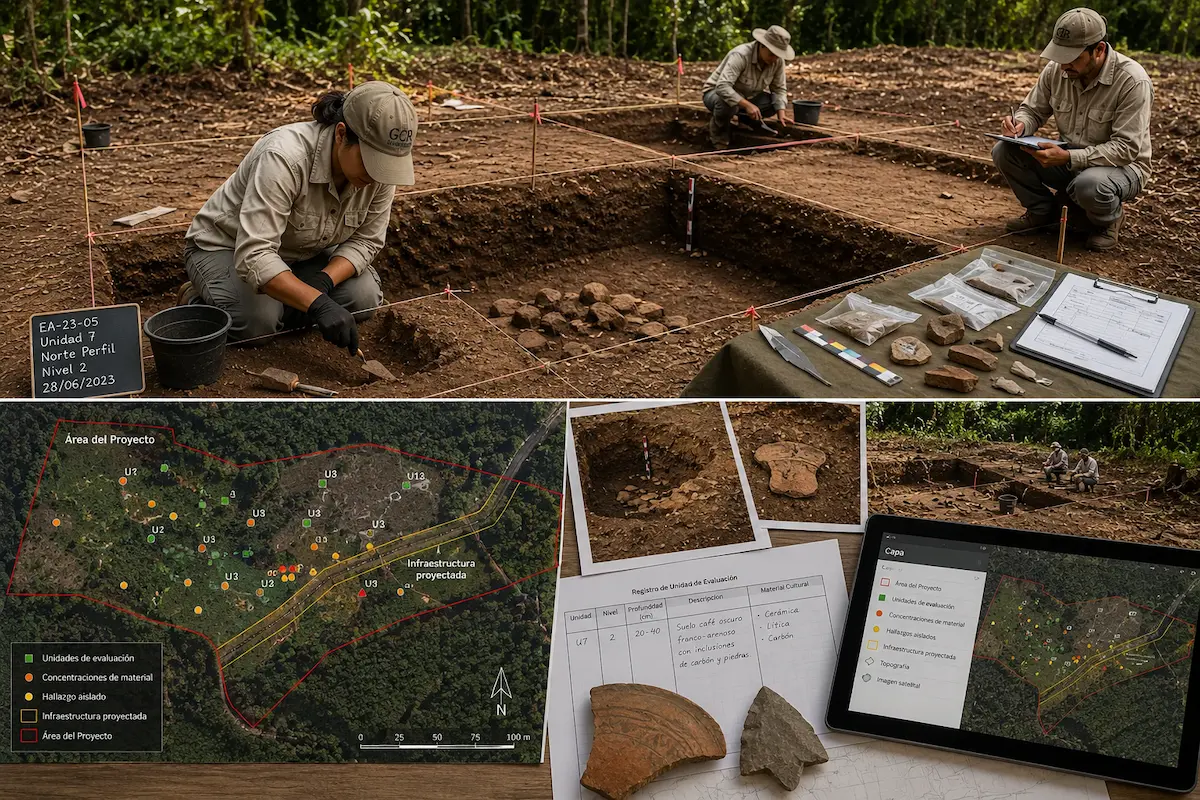
The location of evidence matters as much as its identification
Maps show where assessments were carried out, how evidence is distributed and its spatial relationship to the project area and proposed works.
From individual records to territorial interpretation
- Project area.
- Assessment units.
- Documented evidence and materials.
- Concentrations or spatial patterns.
- Investigated areas.
- Proposed infrastructure.
- Relationship between archaeological evidence and planned works.
- Maps for interpretation and technical reporting.
Field data must become an archaeological interpretation
Spatial distribution, stratigraphy, materials and other observations are integrated to understand the archaeological characteristics of the investigated area.
Distribution
Identifying the areas where evidence is concentrated or distributed.
Stratigraphy
Relating materials to layers and depositional conditions.
Materials
Recording and analyzing recovered materials, as applicable.
Site condition
Assessing disturbance, preservation and relationships with existing interventions.
The assessment helps determine how the project can proceed
The findings support technical recommendations based on the distribution of evidence and its relationship to proposed interventions.
Archaeological assessment follows a specialized procedure
The Comisión Arqueológica Nacional and Museo Nacional have specific roles in authorizing, overseeing and monitoring archaeological investigations in Costa Rica.
Comisión Arqueológica Nacional
Handles professional accreditation and authorization of archaeological investigations under the applicable procedure.
Museo Nacional de Costa Rica
Performs institutional functions related to protection, oversight and management of the country's archaeological heritage.
SETENA
An archaeological assessment may be required based on findings or requirements from a project's environmental assessment.
From background information to interpretation for the project
Review the background
We examine the project, previous findings and available archaeological context.
Define the proposal
We establish objectives, methodology, work areas and schedule.
Obtain authorization
The relevant authorization procedure is completed before the assessment begins.
Investigate in the field
We carry out the authorized activities and document the results.
Analyze the findings
We integrate archaeological information, field records and spatial distribution.
Provide recommendations
We relate the conclusions to the project's needs and next stages.
Organized archaeological information to support project decisions
Findings may determine subsequent actions
Depending on the assessment results, the project may require monitoring during certain activities or additional archaeological intervention.
Archaeological Monitoring of Earthworks
Professional monitoring of specified ground interventions when the project's archaeological conditions require observation during construction.
Archaeological Salvage
When assessment results indicate the need for specialized archaeological intervention, the technical procedure, requirements and applicable institutional authorizations must be established before work continues.
Before starting an Archaeological Assessment
Is this the same as a Rapid Archaeological Report?
No. The rapid report is an initial assessment. An Archaeological Assessment investigates previously identified conditions in greater detail.
Does it always require excavation?
The methodology depends on the objectives and the authorized proposal. Different research techniques may be used depending on the case.
Can work begin immediately?
A formal Archaeological Assessment must first follow the institutional procedure and obtain the corresponding authorization.
How does it relate to SETENA?
An assessment may arise from findings or recommendations in the archaeological component of an environmental file, but the investigation follows the specialized archaeological procedure.
Does an assessment mean the project cannot proceed?
Not necessarily. Its purpose is to gather information about existing conditions and establish appropriate recommendations.
What does Geo Costa Rica need to review the case?
We can start with the location, property survey plan, project design, available archaeological background and any prior studies.
Does your project need a more detailed investigation of archaeological conditions?
We can review background information, previous inspection results and the location of proposed works to define the professional scope and next steps of the archaeological process.
Review the case together
Send us the property's location, survey plan, available project design and any previous archaeological reports.