



Stream and Spring Flow Measurement
We measure stream, river and spring discharge using methods suited to each source, documenting the observed flow rate under specific conditions.
A flow measurement determines how much water a source carries under the conditions present at the time of measurement
Flow measurement quantifies the discharge moving through a river or stream, or issuing from a spring, using a method appropriate to the site's physical characteristics.
The result is normally expressed as a flow rate, for example in liters per second (L/s) or cubic meters per second (m³/s), depending on the size of the source.
However, the reading must always be associated with the location, date and conditions in which it was taken. Natural-source discharge can change with season, recent rainfall and the behavior of the contributing catchment or aquifer.
- Identifies the measurement location.
- Records field conditions.
- Uses a method appropriate to the source.
- Determines and documents the measured discharge.
Observed discharge does not mean year-round availability
A measurement indicates the discharge observed under particular conditions. On its own, it does not establish how much water the source can provide throughout the year or how much can legally be used.
When assessing water supply or availability, the reading must be interpreted alongside additional information about the source and the project's water needs.
Measuring today's flow is not the same as determining the source's year-round yield.
Rivers, streams and springs are not necessarily measured in the same way
The method is selected based on source type, discharge, available geometry, flow conditions and the practical feasibility of field measurements.
Cross-section and velocity measurement
Where a suitable gauging cross-section can be established, discharge can be estimated from the wetted area and water velocity.
The cross-section is divided into segments, in which depths and velocities are recorded. These observations are used to integrate the flow passing through the channel.
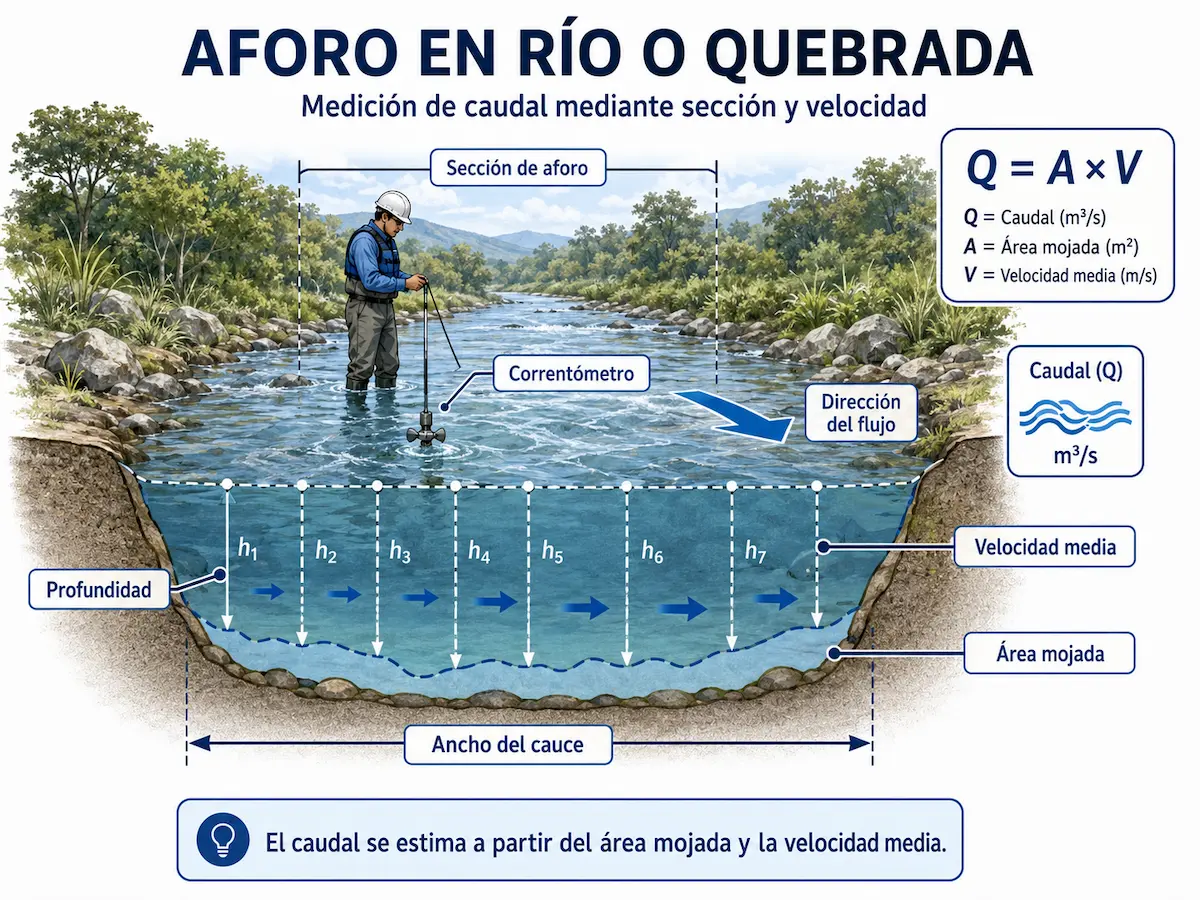
Conceptually: discharge = wetted area × mean velocity. In practice, the cross-section and flow distribution must be adequately represented.
Where conditions allow, discharge can be measured directly using volume and time
For springs or small flows, the volumetric method can be used when the water can be adequately concentrated at one point and collected in a container of known volume.
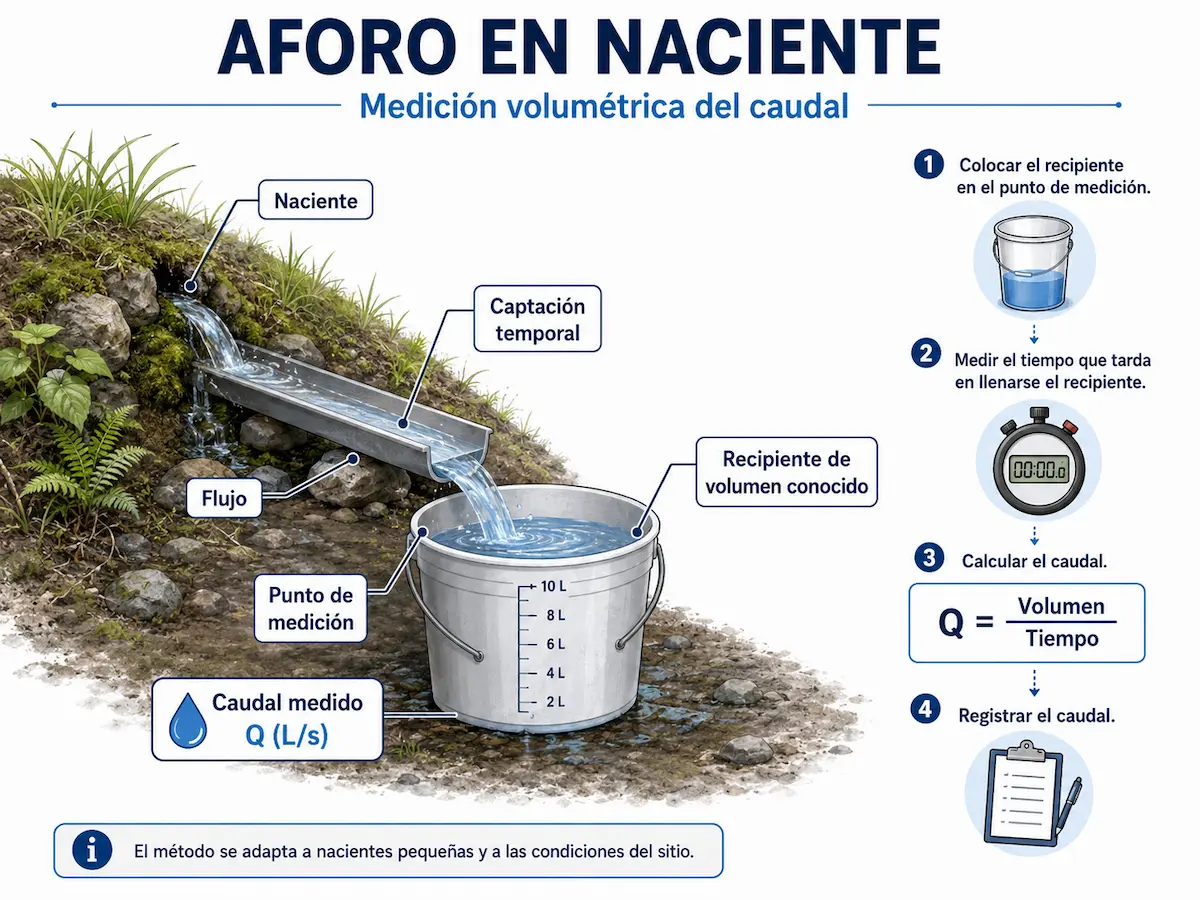
A simple relationship that requires careful measurement
When the entire flow can be collected, the collected volume and the filling timeare recorded.
Several consecutive measurements can be made to improve representativeness and check the consistency of the results.
The volumetric method is not universally applicable. If spring conditions prevent the entire flow from being collected, another technique suited to the site must be selected.
We select the point, measure discharge and document source conditions
Good flow measurement involves more than obtaining a number. The location, method and observed conditions all contribute to interpreting the result.
Select the location
We inspect the source and choose a section where conditions allow a representative and technically appropriate measurement.
Measure discharge
We apply the selected method and record the dimensions, velocities, volumes, times or other variables required for that type of measurement.
Calculate and document
We process observations, calculate discharge and document the location, method and conditions present at the time of measurement.
Context is essential to interpreting the measured value correctly
Today's observed discharge does not necessarily represent the source's minimum or maximum flow
Rivers, streams and springs are natural systems that change over time. The reading must be interpreted in light of the conditions under which it was taken.
Discharge can vary throughout the year
Dry and rainy seasons, recent precipitation, catchment storage and the behavior of the system feeding the source can all affect observed discharge.
- Dry or rainy season.
- Recent rainfall.
- Catchment conditions.
- How the source responds over time.
Repeated measurements provide a better understanding of source behavior
Where variability needs to be assessed, measurements can be taken at different times to build a more representative time series than an isolated reading.
- Compare different seasons.
- Identify trends.
- Record critical conditions.
- Strengthen subsequent assessments.
A single measurement is a snapshot of discharge under particular conditions. A series of measurements helps reveal how the source changes over time.
A documented measurement that can inform subsequent assessments and decisions
The report organizes the field information so that the result can be understood in the source's actual context.
What may be included in the report?
- Source identification and location.
- Exact measurement point.
- Date and measurement conditions.
- Description of the method used.
- Field data and calculations.
- Measured discharge.
- Photographic record.
- Observations and technical interpretation.
When might a flow measurement be needed?
- Assessment of a spring, river or stream.
- Preliminary assessment of a water-supply source.
- Monitoring flow over time.
- Environmental studies.
- Water-resource assessments.
- Supporting information for certain institutional procedures.
Measuring discharge does not constitute authorization to use the water
Flow measurement provides technical data about the source. Where water use is proposed, the result may support subsequent studies or procedures, but authorization and applicable conditions are determined by the competent authority.
Explore permits and proceduresFlow measurement quantifies source discharge; other studies use that information to address different questions
Discharge measurements can contribute to broader assessments of catchment response, source capacity or project water requirements.
Water Source and Demand Assessment
Uses source information to compare available flow with a project's anticipated water requirements and evaluate the relationship under the assessed scenario.
View Water Source and Demand AssessmentHydrological Study
Examines how rainfall and catchment characteristics generate runoff and supports flow estimates under different scenarios.
View Hydrological StudyPumping Test
For wells, hydraulic behavior is assessed through a pumping test relating pumping rate, water levels, drawdown, time and recovery.
View Pumping TestFlow measurement ≠ Hydrological Study. Flow measurement directly records discharge at a source; a hydrological study estimates catchment response under defined conditions and scenarios.
Frequently asked questions about stream and spring flow measurement
Does one measurement indicate how much water is available all year?
No. It reflects the conditions at the time of measurement. Understanding variability may require measurements at different times and consideration of additional information.
Are springs and rivers measured in the same way?
Not necessarily. The method depends on discharge, geometry, accessibility and physical conditions at the site. A small spring may allow volumetric measurement, while a river may require cross-section and velocity measurements.
Is the measured flow automatically the amount I can use?
No. Measurement provides technical information on the source. The possibility and conditions of use require the relevant assessment and, where applicable, authorization from the competent authority.
Is flow measurement the same as a Hydrological Study?
No. Flow measurement directly records existing discharge at a point. A hydrological study analyzes catchment response and may estimate flows under different rainfall scenarios.
Do you need to measure the discharge of a river, stream or spring?
Geo Costa Rica measures water-source discharge using methods tailored to the source type and actual field conditions, documenting both the result and its technical context.
We can review your project objectives and determine the most suitable measurement method and level of information for the source you need to assess.