




Environmental Compensation Plan (ECP) for SETENA
We design environmental compensation measures that are technically related to the impact to be addressed, defining their location, scope, actions, responsible parties, indicators and monitoring for SETENA's assessment.
Compensation means creating a benefit related to an impact that must be addressed
An Environmental Compensation Plan brings together measures and actions intended to generate environmental and social benefits proportionate to impacts, damage, harm or environmental noncompliance associated with an activity, work or project.
An identifiable impact exists
First, we must understand which resource, environmental function, commitment or condition was affected and the extent of the problem to address.
A related measure is proposed
The compensatory action must be technically justified in relation to the identified impact and produce a verifiable environmental or social benefit.
It must be demonstrable
Compensation requires actions, responsible parties, deadlines and indicators that subsequently allow its implementation and outcomes to be verified.
Compensation does not replace the obligation to prevent, mitigate or correct
Environmental management must first seek to avoid and reduce impacts. Compensation becomes appropriate when an impact requires an additional and technically proportionate response.
Prevent
Avoid the impact when a technically feasible alternative exists.
Mitigate
Reduce the intensity, extent or duration of environmental effects.
Correct or restore
Recover affected conditions when technically feasible.
Compensate
Generate a proportionate benefit in response to the impact being addressed.
A compensatory measure within an EMP does not necessarily mean that a separate ECP exists
An Environmental Management Plan may include prevention, mitigation, correction, compensation and restoration measures. A specific ECP addresses a particular compensation need within the relevant environmental procedure.
A Compensation Plan may be required during assessment or environmental management
The need for compensation depends on the case file, the identified impact and SETENA's determination within the applicable procedure.
Compensation included in project evaluation
During assessment, impacts may be identified whose management requires compensatory measures and submission of the corresponding plan for review.
Noncompliance or impacts during implementation
An ECP may also arise during environmental management when noncompliance, damage or harm is detected and additional measures are needed.
Corrective measure within a procedure
In certain environmental proceedings, SETENA may require corrective measures that include submitting a Compensation Plan.
Specific SETENA requirement
When a specific resolution, information request or institutional assessment exists, the ECP must directly address the requirements of the case file.
Does the proposed measure actually compensate for the identified impact?
Proportionality is not simply a matter of comparing areas. We must understand which environmental component was affected, the function it performed and the benefit the proposed measure can generate.
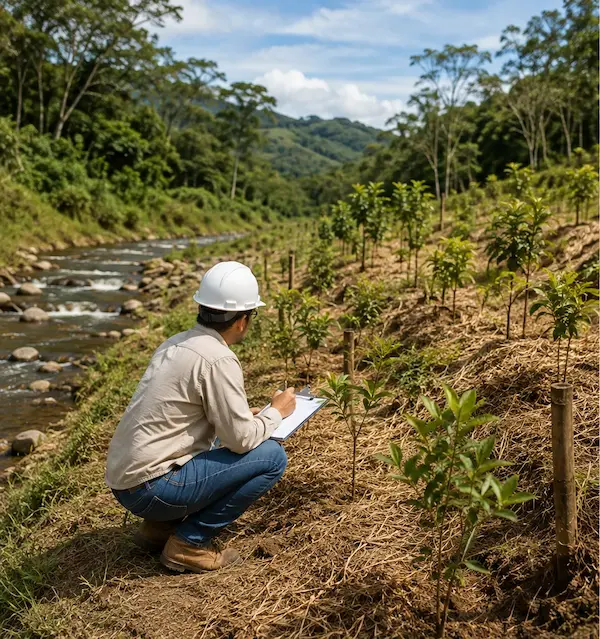
A Compensation Plan is not limited to planting trees
Measures must be selected according to the affected resource, local conditions, compensation objectives and the specific requirements of the case file.
Recovery of degraded areas
Actions designed to improve ecological conditions and restore degraded environmental functions.
Revegetation and reforestation
Establishing vegetation cover with defined objectives, species, maintenance and indicators.
Protection of water resources
Measures to restore or strengthen functions associated with watercourses, springs, riparian areas or recharge zones.
Habitat and ecological connectivity
Actions intended to improve the continuity, protection or quality of relevant habitats.
Strengthening environmental functions
Compensation may focus on relevant ecosystem services within the area of influence.
Environmental and social benefits
Depending on the case, measures offering social benefits may be included, provided they form part of a technically substantiated proposal.
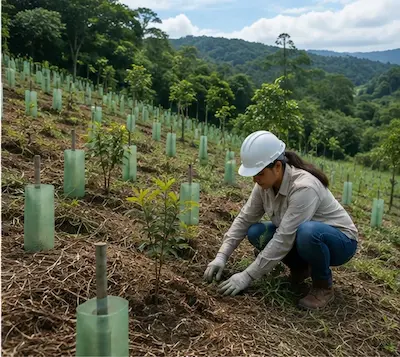
Choosing where to implement a measure can be as important as deciding what to do
Location must be assessed considering the affected resource, relationship to the project, land availability, connectivity, protected areas and the practical ability to implement and maintain the measure.
Every measure must be explainable, locatable, implementable and verifiable
Impact
We clearly describe the impact, damage or noncompliance giving rise to the measure.
Measure
We define the proposed compensatory action and its objective.
Location
We determine where it will be implemented and its relationship to the surrounding area.
Implementation
We establish activities, responsible parties, resources and schedule.
Indicators
We define how progress and outcomes will be verified.
Monitoring
We schedule monitoring and collection of evidence until compliance can be demonstrated.
Effective compensation must relate to the impact and remain viable over time
Proposing a positive environmental action is not enough. The measure must address the identified problem, be feasible in its location and include criteria for subsequently verifying its implementation and outcomes.
Address the affected resource
An impact on water, vegetation, habitat or soil does not necessarily call for the same compensation. The measure must reflect the environmental component actually affected.
Match the scale of the impact
The scope of compensation must be justified in terms of the extent, intensity, duration and characteristics of the impact to be addressed.
Choose a suitable site
The location must deliver a genuine benefit and be compatible with the site's environmental, legal and territorial conditions.
Be practically implementable
Suitable technical conditions, access to land, responsible parties, resources and timelines must be available to implement and maintain the proposed measure.
Continue beyond the implementation date
Measures such as restoration or revegetation need maintenance and monitoring so their environmental benefits can become established over time.
Demonstrate the outcome
Indicators, photographs, locations, field records and other verification tools help demonstrate what was implemented and how the measure evolved.
Compensation must be implemented and deliver demonstrable results
Approval of a measure does not mean the impact has already been compensated. Outcomes depend on implementation, maintenance, monitoring and evidence demonstrating that objectives have been achieved.
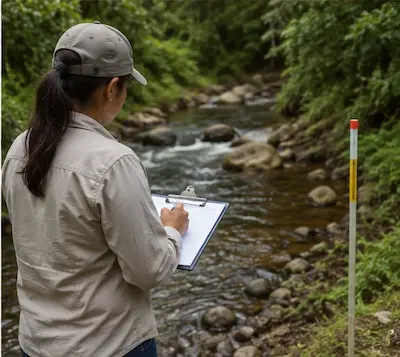
Compensation, management and monitoring serve different purposes
Environmental Compensation Plan
Addresses a specific compensation need and sets out the actions required to respond to it.
Environmental Management Plan
Provides a broader framework of environmental measures designed to manage project impacts.
View Environmental Management PlanEnvironmental Compliance Monitoring
May subsequently support the implementation, documentation and monitoring of approved measures.
View Environmental Compliance MonitoringWe turn a compensation obligation into a technically implementable program
We combine case-file information, field inspections, mapping and relevant professional disciplines to define a realistic, justifiable and verifiable measure.
From an identified impact to verifiable compensation
Review
We review the case file and the reason compensation is required.
Assess
We characterize the impact and site conditions.
Design
We define alternatives and select the proposed measure.
Georeference
We map the affected area and compensatory actions.
Submit
We compile the Plan for assessment under the applicable procedure.
Monitor
We support the verification of progress and outcomes where applicable.
Environmental Compensation Plans for SETENA
SETENA evaluates proposed measures in the context of the case file and determines the conditions for their implementation and verification.
National Environmental Technical Secretariat
SETENA
Acceptance of a measure is the responsibility of the environmental authority
Geo Costa Rica prepares the technical proposal and documentation within the contracted scope, but SETENA is responsible for reviewing the Plan and deciding whether to accept it, request modifications or impose additional requirements.
Once the measures are approved, the developer must implement them and demonstrate compliance under the conditions established for the case file.
Executive Decree No. 43898-MINAE-S-MOPT-MAG-MEIC
The applicable regulation defines Environmental Compensation Plans and compensation measures within the Environmental Assessment, Control and Monitoring system administered by SETENA.
Environmental compensation plans and measures
Does every environmental impact require an ECP?
No. Many impacts are managed through prevention, mitigation, correction or restoration measures within the project's environmental instrument. A specific ECP addresses a particular need for compensation.
Is an ECP only submitted when a penalty has been imposed?
No. It may arise during environmental assessment or subsequently during management, monitoring, complaint proceedings or the handling of noncompliance.
Does compensation always mean reforestation?
No. Measures depend on the affected resource and may involve restoration, revegetation, water protection, connectivity, ecosystem services or other justified actions.
Must compensation take place on the same property?
It depends on the objective, the impact and the conditions established for the case. The location must be technically justified and suitable for implementing and maintaining the measure.
Can SETENA request changes to the Plan?
Yes. The environmental authority reviews the proposal and may request clarifications, adjustments or additional information before accepting the measures.
What do we need to get started?
Primarily the case-file number, resolution, information request or official communication regarding compensation, project location and any available reports or background describing the impact.
Has SETENA required you to submit environmental compensation measures?
We can review the case file and identified impact to develop a technically substantiated, spatially feasible compensation proposal with verifiable outcomes.
Let's review the requirement
Send us the case-file number, SETENA resolution, official communication or information request, along with the project location and available background documents.