




Wastewater Treatment System Siting Approval
Geo Costa Rica assesses the property, proposed system location, setbacks, water bodies, wells, and treated effluent disposal options to prepare and manage the Siting Approval application before the Ministry of Health.
What is the Siting Approval for a treatment system?
This is the procedure through which the Ministry of Health assesses the proposed location of a wastewater treatment system within a project and the surrounding land-use conditions.
The purpose is not yet to approve the complete construction design of the plant, but to verify that the location designated for the system can be assessed in the context of the overall project and its surroundings.
The assessment considers the proposed location, preliminary dimensions, setbacks, buildings, water bodies, water supply wells, and the intended final disposal method for treated wastewater.
Does my project require Siting Approval?
Not all sanitation systems necessarily follow the same procedure. The type of system, flow rate, final disposal method, and project characteristics must first be reviewed.
What sanitation solution is proposed?
Determine whether the project proposes a treatment plant, an individual system, disposal through drainage, or another sanitation solution.
How much wastewater will be generated?
The system flow rate and projected water consumption are relevant in determining the applicable regulatory procedure.
Where will the treated effluent go?
Infiltration, sewerage, receiving water body, reuse, and other options may involve different technical and institutional requirements.
Current Ministry guidance identifies this procedure for systems with influent flows greater than 5 m³/day and also specifies conditions for disposal through drainage when actual or projected drinking water consumption exceeds 190 m³ per month.
Review the location before completing the system design
A technically well-designed system can still cause problems if it is located in an area incompatible with setbacks, buildings, surface water, wells, or the intended final disposal method.
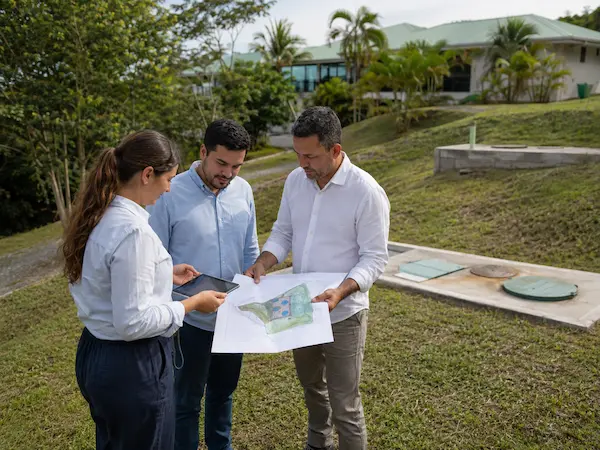
Geo Costa Rica examines the proposed location within the property to identify potential conflicts that should be resolved before proceeding with construction drawings and other project investments.
- Available space for the system.
- Relationship to property boundaries and buildings.
- Topography and site configuration.
- Water bodies and drainage features.
- Nearby water supply wells.
- Proposed treated effluent disposal option.
- Access and relationship to the rest of the project.
Changing a location during the conceptual stage is generally much easier than doing so after detailed design is complete.
What do we assess on the site?
The system location must be understood within the entire project, not as an isolated installation placed in whatever space remains.
We combine field inspection, drawings, mapping, and spatial analysis to determine how the system relates to the property and its immediate constraints.
- Property boundaries and geometry.
- Proposed system location.
- Preliminary dimensions.
- Existing and proposed buildings.
- Access and circulation areas.
- Slopes and surface drainage.
- Existing infrastructure.
- Relevant environmental conditions.
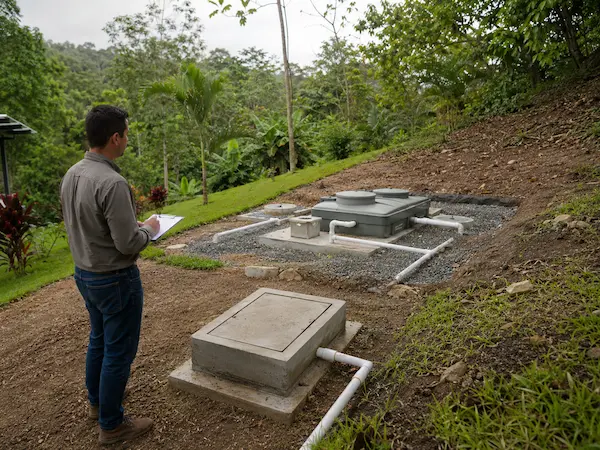
Setbacks and the system's relationship to the project
The site plan must show how the proposed system area relates to boundaries, buildings, and other relevant project features.
Boundaries
The location must allow identification and measurement of setbacks between the treatment system and the property boundaries.
Buildings
The relationship to existing or proposed buildings on the same property must also be shown.
Access and functionality
In addition to spatial requirements, the location must be functional for future operation, inspection, and maintenance.
Wells, groundwater, and hydrogeological constraints
Nearby water abstraction points must be included in the assessment to understand the relationship between the proposed system and water resources.

The Siting Approval documentation must identify existing or proposed water supply wells within the property and certain nearby abstraction points.
The current procedure also requires identifying existing water supply wells on adjacent properties within a radius of 100 meters from the treatment plant.
Where project conditions warrant, Geo Costa Rica can expand the assessment to include hydrogeological information, aquifers, springs, and other sensitive features to better understand the feasibility of the proposed sanitation solution.
Water bodies and site drainage
Streams, rivers, and other drainage features can affect both the system location and the selected option for treated effluent disposal.
What water bodies are present?
We review mapping, the site, and available records to identify water features that may be relevant to the project.
Where does the site drain?
The plan must show the flow direction of water bodies that cross or border the property.
Will the effluent be discharged into a receiving water body?
If the proposed solution involves discharge into a receiving water body, the Water Directorate's applicable procedures must also be reviewed.
Where will the treated wastewater ultimately go?
The Siting Approval requires identifying and justifying the proposed final disposal option for the effluent.
Connection to a sewer system
Where a sewer network is available, the feasibility and conditions for conveying treated effluent into that system must be assessed.
Infiltration into the ground
Disposal through infiltration requires an evaluation of soils, hydrogeological conditions, and any other applicable project requirements.
Discharge of treated wastewater
Where the effluent will be discharged to a receiving water body, the applicable conditions and authorizations under the discharge regulations must also be met.
Final disposal must be determined case by case
The regulatory framework also provides for alternatives such as reuse, submarine outfalls, or evaporation when technically and legally applicable.
Geo Costa Rica reviews the project circumstances before determining the appropriate institutional procedure.
How does Geo Costa Rica handle Siting Approval?
We integrate the site's territorial assessment with project information and the proposed sanitation solution.
What does the Ministry of Health assess?
The Ministry reviews the submitted information to determine whether the requested Siting Approval should be granted.
General characteristics
The overall project, location, owner, activity, and general characteristics of the proposed system are identified.
Placement within the property
The proposed area, preliminary dimensions, setbacks, and relationship to other elements shown on the site plan are reviewed.
Final disposal
The intended final disposal method for treated wastewater must be identified and technically justified.
Geo Costa Rica does not guarantee that Siting Approval will be granted. We prepare and support the application technically; the Ministry of Health conducts the assessment and issues the corresponding decision.
What happens after obtaining Siting Approval?
Siting Approval allows the project to proceed to subsequent stages, but does not constitute comprehensive approval of the system's construction design.
Detailed construction design follows a separate procedure
The Ministry of Health has a specific procedure for Approval of Construction Drawings for Wastewater Treatment Systems, processed digitally through the CFIA APC platform.
What information do we need to get started?
We can conduct a preliminary review of the proposed location even if the system design is not yet complete.
Site
- Cadastral survey plan.
- Property location.
- Property area.
- Available property registration information.
Proposed development
- Available site layout.
- Project use.
- Expected capacity or population.
- Preliminary system location.
Proposed solution
- Proposed system type.
- Estimated flow rate.
- Proposed final disposal method.
- Existing studies or background information.
How do we approach Siting Approval?
The process aims to identify conflicts early and propose a location that is technically compatible with the project.
Questions about treatment system siting
Answers for projects that must determine where to locate their system before proceeding with design.
What is Siting Approval from the Ministry of Health?
It is the procedure through which the Ministry assesses the proposed location of a treatment system within a project before subsequent construction-related stages.
Should it be requested before the plant design is completed?
Yes. Its purpose is to assess the location before the subsequent construction drawing approval process, helping identify spatial conflicts early.
What does Geo Costa Rica review before submitting the application?
We review the site, proposed location, project, setbacks, water bodies, wells, maps, and the intended treated effluent disposal option.
Must nearby wells be identified?
Yes. The procedure requires showing wells on the property and existing water supply wells on adjoining properties within the applicable institutional radius.
What is the radius for wells on adjoining properties?
Current Ministry guidance specifies a radius of 100 meters from the treatment plant for existing water supply wells on adjacent properties.
What if there is a stream or river nearby?
It must be included in the assessment and maps. If effluent is discharged into a receiving water body, other institutional procedures may also apply.
Can the plant discharge into the ground?
Infiltration may be an option in some cases, but applicable technical, sanitary, and hydrogeological conditions must be met.
Does Siting Approval replace the Wastewater Discharge Permit?
No. If treated wastewater is discharged into a receiving water body, the corresponding Water Directorate procedure must also be assessed.
Does Siting Approval approve the construction drawings?
No. The Ministry has a separate subsequent procedure for Approval of Construction Drawings for Wastewater Treatment Systems.
How long does the Ministry of Health take?
Current institutional guidance indicates a period of 22 calendar days to issue a decision. This institutional period should not be confused with the time required to prepare information or address possible requests for additional documentation.
How long is Siting Approval valid?
Current institutional guidance establishes a validity period of two years from the date of issuance.
Does Geo Costa Rica design the treatment plant?
Geo Costa Rica focuses on territorial assessment, hydrogeology, mapping, final disposal, and institutional procedures. When a project requires sanitary, hydraulic, or electromechanical design subject to specific professional responsibilities, that component must be prepared by a suitably qualified professional.
Related studies and procedures
The next steps depend on how the project's wastewater will be treated and where it will ultimately be disposed of.
Wastewater Treatment Systems
We assess the project's sanitation solution and the institutional procedures related to treatment and final disposal.
Sanitary Sewer Exemption
For certain residential projects where the sanitation solution requires hydrogeological studies, infiltration tests, and contaminant transport analysis.
Wastewater Discharge Permit
Applicable where treated wastewater is discharged into a receiving water body regulated under the discharge regime.
Do you already know where you want to locate the treatment system?
We can review the site, proposed location, water bodies, wells, setbacks, and disposal option before the project proceeds too far with a location that could create conflicts.
Send us the cadastral survey plan, site layout, and available system information. You do not need a completed construction design for an initial review.