



Infiltration Tests
We assess the capacity of soil to absorb water through field tests selected according to site conditions, the depth of interest and the project objectives. This technical report provides key information for drainage, wastewater disposal, groundwater recharge assessments and interpretation of local hydraulic behavior.
Infiltration tests help explain how water enters the soil
Their primary purpose is to measure the infiltration rate or capacity of the ground under controlled field conditions. The results support technical decisions regarding stormwater drainage, runoff management, wastewater disposal, infiltration structures and investigations of subsurface hydraulic behavior.
At Geo Costa Rica, we prepare these technical reports by selecting the most appropriate method for the material, investigation depth, groundwater level, project objectives and required level of detail.
Practical applications
Supports the design and assessment of structures where soil infiltration affects the technical solution.
Field measurements
Results are not based on generic estimates: they are obtained from tests conducted directly at the site.
Technical interpretation
Measured values must be interpreted in the geological, hydraulic and construction context of the project.
Different tests answer different questions
The method depends on the type of structure, the depth to be investigated, the material present and how water interacts with the soil or subsurface. Rather than simply applying a standard test, sound technical judgment means choosing the procedure that best represents the conditions under assessment.
Depth
Ground surface, shallow zones or greater depths, depending on the question to be answered.
Material type
Fine-grained soils, granular soils, heterogeneous profiles or more permeable materials.
Project objective
Drainage, infiltration, sanitation, stormwater management or hydrogeological interpretation.
Site conditions
Accessibility, available excavations, presence of water and feasibility of field testing.
Each test examines infiltration under different conditions
The following are common methods that may be included in a technical infiltration report. In practice, the appropriate test depends on the specific circumstances; not every method is applicable to every project.
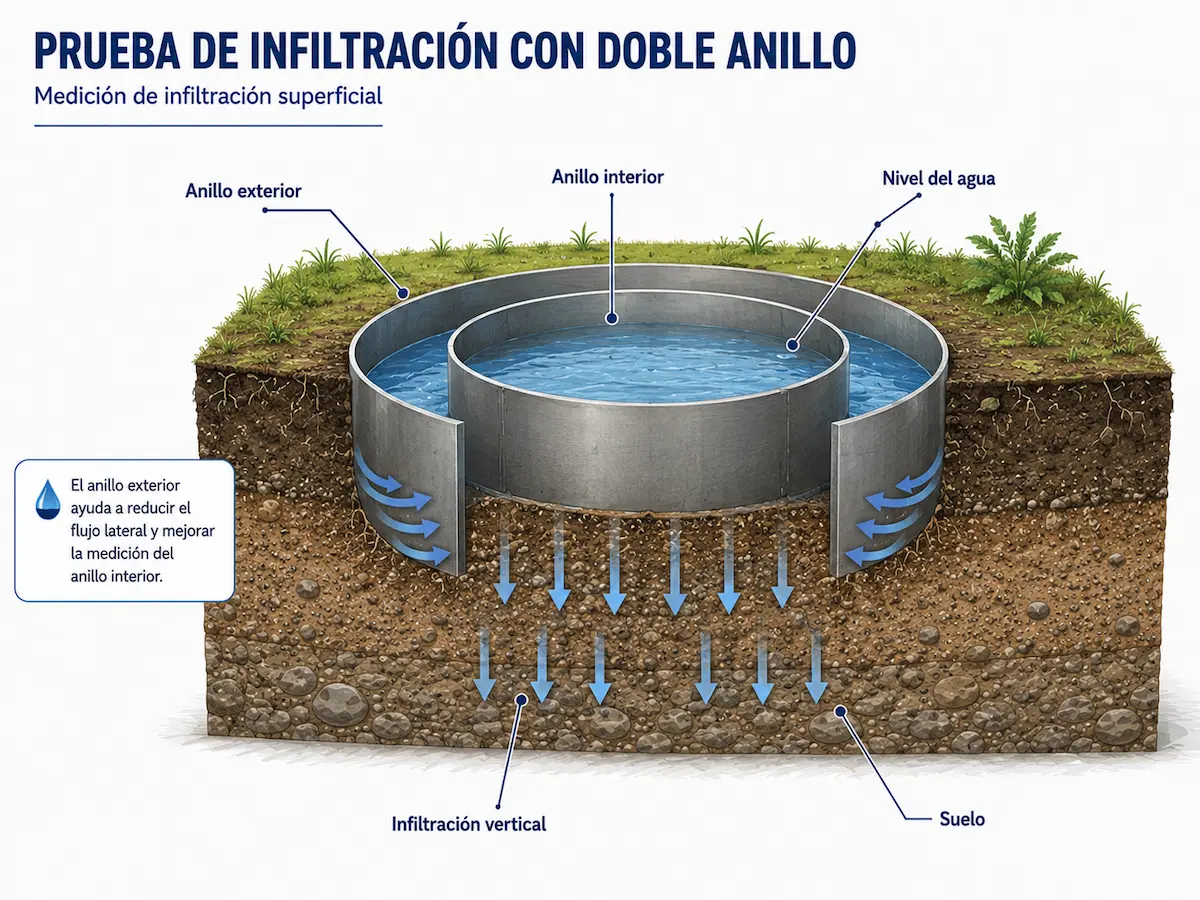
Double-ring infiltrometer test
This surface test uses two concentric rings to reduce lateral flow, focusing the measurement on vertical water infiltration into the soil.
It is particularly useful for assessing near-surface layers in projects where the capacity of the ground to absorb water from the surface is important.
- Surface test.
- Helps estimate direct infiltration into the ground.
- Commonly used for stormwater management and infiltration area assessments.
Porchet infiltration test
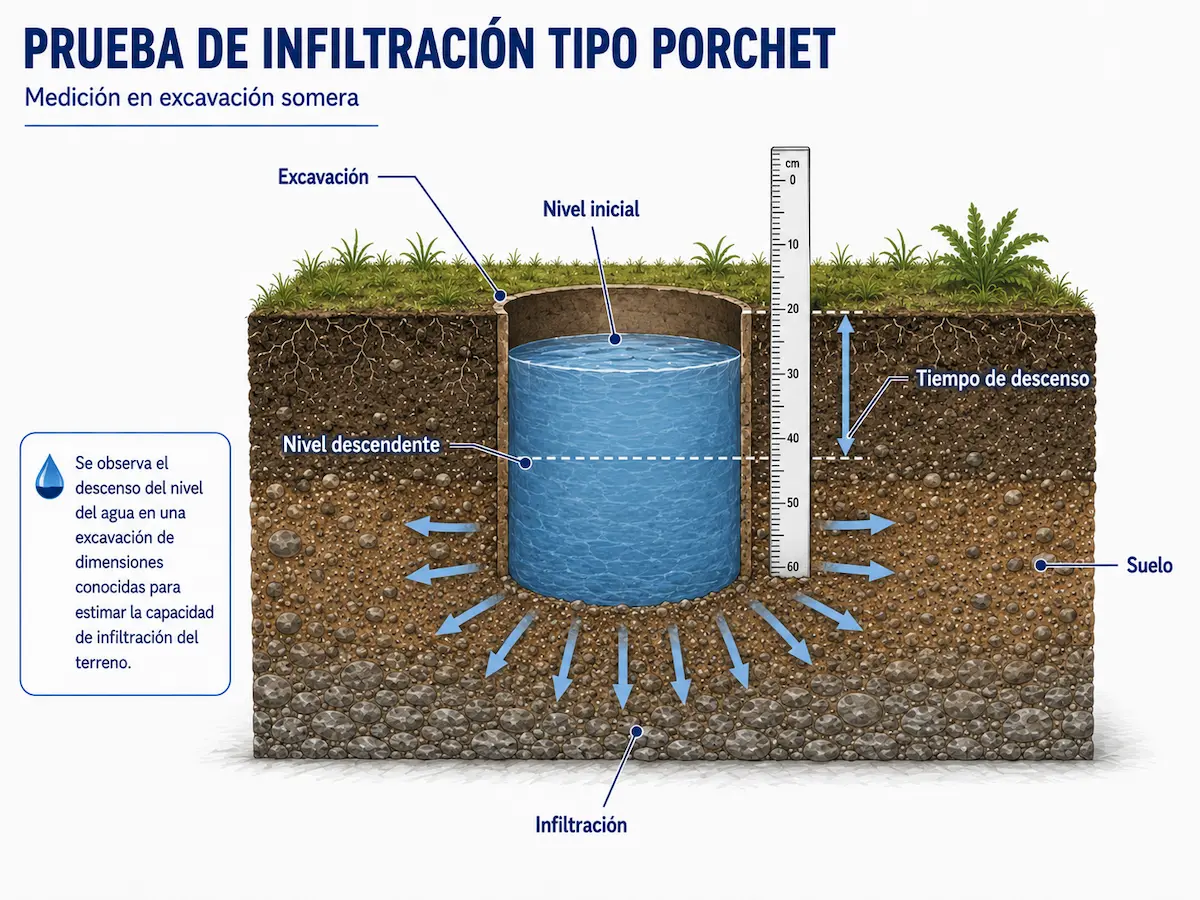
The Porchet method is conducted in an excavation or shallow borehole, observing water loss into the surrounding ground from a controlled water level.
It is useful for assessing infiltration at a localized point, more representative of a cavity or discharge location than of the soil surface alone.
- Test conducted in a localized excavation.
- Allows infiltration to be assessed at shallow depth.
- Useful for localized discharge or absorption solutions.
Guelph permeameter test
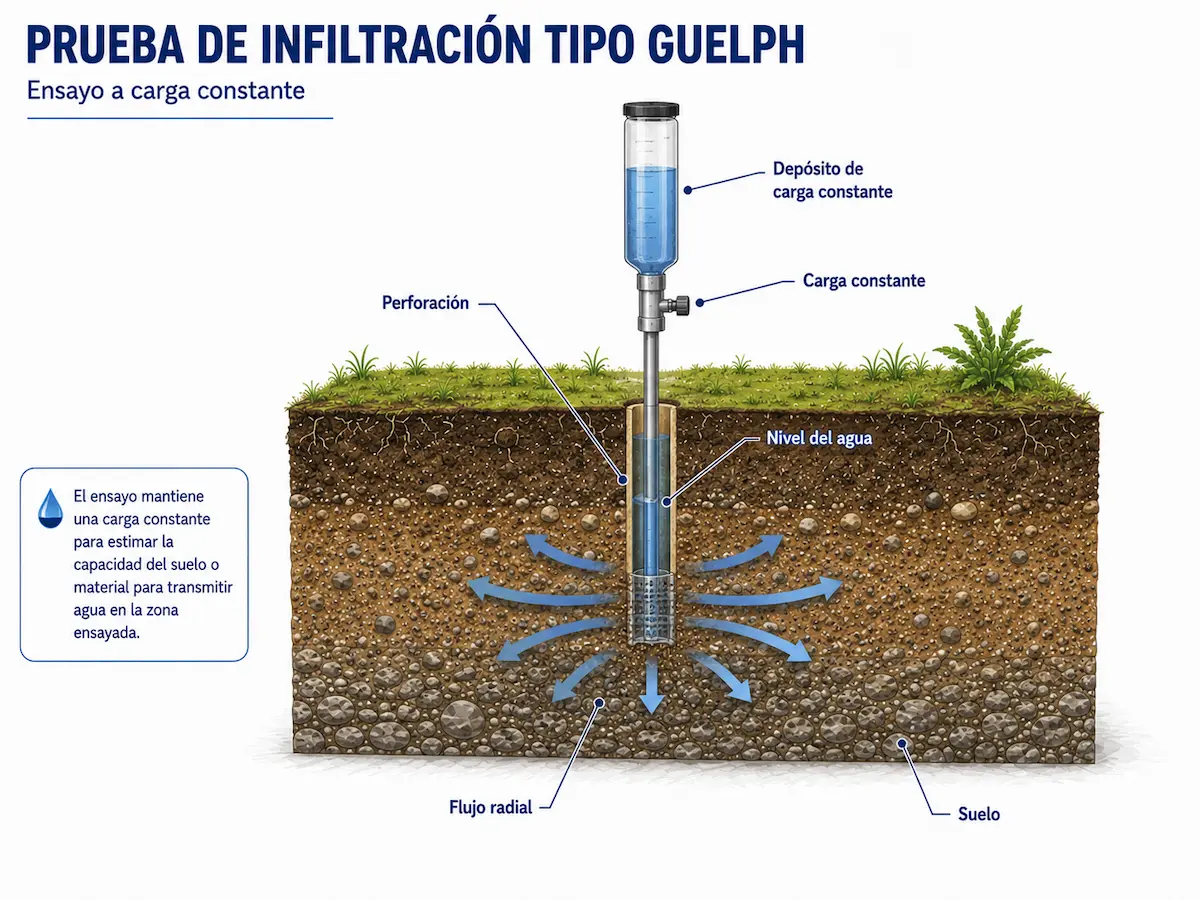
The Guelph test is performed in a borehole under controlled hydraulic heads to estimate soil behavior as water enters the ground.
This method is valuable when a more detailed assessment of subsurface flow and parameters related to hydraulic conductivity is required in unsaturated or partially saturated materials.
- Borehole test.
- Uses a controlled hydraulic head.
- Can provide useful information on local hydraulic conductivity and infiltration.
Lefranc permeability test
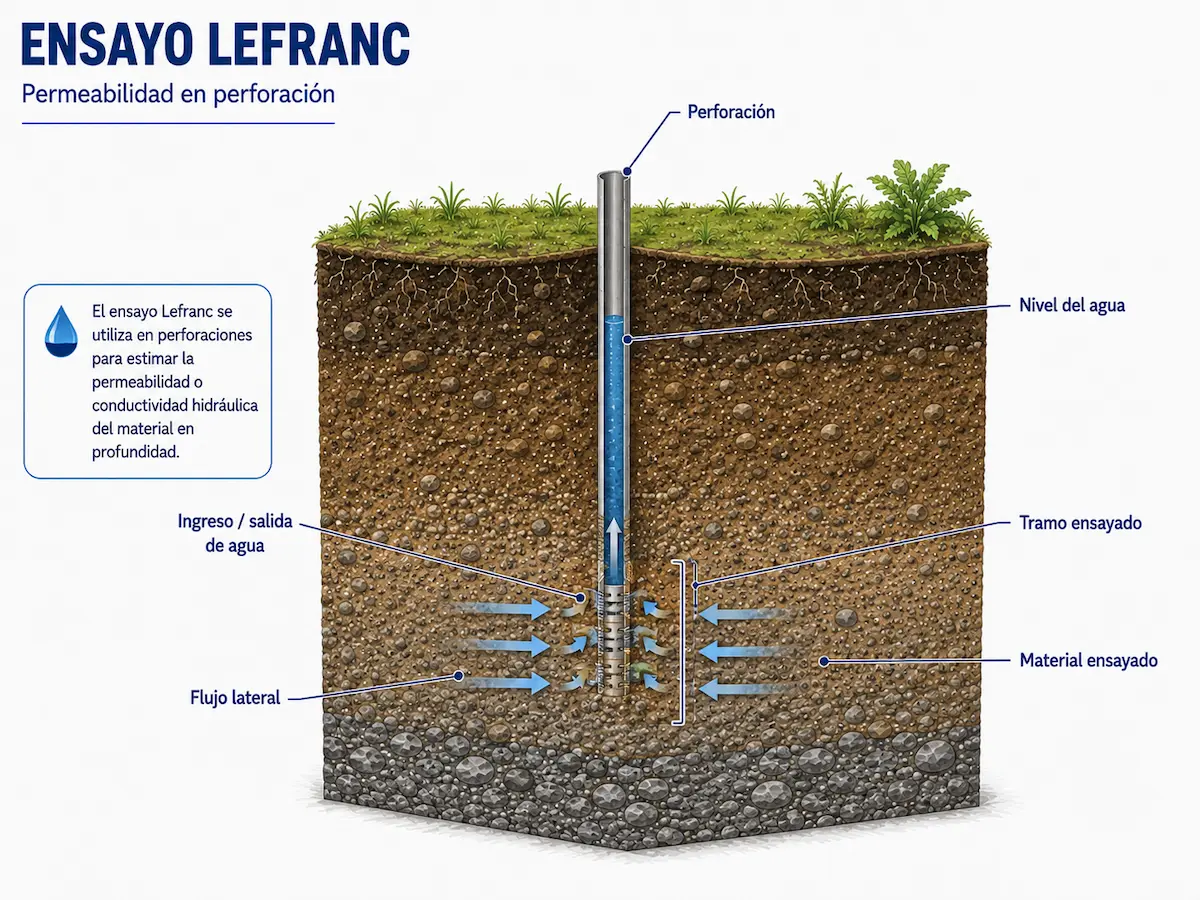
The Lefranc test is conducted in boreholes to assess the hydraulic behavior of a defined subsurface interval, generally focusing more on permeability or hydraulic conductivity than on surface infiltration alone.
It is particularly useful when a project requires an understanding of deeper hydraulic behavior, the ability of a layer to transmit water or more detailed subsurface characterization.
- Test in a borehole or isolated interval.
- Supports interpretation of subsurface permeability.
- Applicable when the assessment requires investigation at greater depth.
The report goes beyond measurements to interpret site conditions
Geo Costa Rica technical reports combine test execution, field records, results analysis and interpretation relevant to the project objectives.
Typical report contents
- Site description and study objectives.
- Selected test method and technical justification.
- Field procedure and observed conditions.
- Results, calculations and interpretation.
- Conclusions and technical recommendations for the project.
Potential applications
- Design of infiltration or drainage structures.
- Assessment of wastewater disposal alternatives.
- Supporting environmental or technical procedures.
- Understanding local hydraulic behavior.
- Identifying water management alternatives.
Infiltration tests may be complemented by other studies
Depending on the project, this report can be combined with hydrological, hydrogeological or water resource studies to better understand how water behaves at the site.
Pumping Test
When the focus is on the behavior of a groundwater abstraction well.
View reportHydrogeological Study
When the subsurface system needs to be understood beyond a single test.
View reportHydrological Study
When the question involves rainfall, runoff and watershed response.
View reportFrequently Asked Questions About Infiltration Tests
The appropriate method depends on which ground property needs to be measured, at what depth, and how the results will be used.
Which infiltration test does my project need?
It depends on the study objective, the depth to be characterized and site conditions. The double-ring test mainly assesses surface infiltration; Porchet and Guelph tests investigate localized conditions at shallow depths; and methods such as Lefranc are used to evaluate the hydraulic behavior of materials within boreholes.
What is the difference between double-ring, Porchet, Guelph and Lefranc tests?
These are not interchangeable versions of the same test. They differ in test geometry, investigation depth and the hydraulic property that can be interpreted. The method should be selected according to the technical question being addressed.
Does an infiltration test determine aquifer recharge?
No. The test measures the behavior of the ground as water enters at the test location. Recharge also depends on precipitation, evapotranspiration, runoff, soil moisture, land cover, geology and other conditions. Infiltration may be an input to a Water Balance Assessment, but does not by itself determine recharge.
Does one test represent the entire property?
Not necessarily. Soil types, fills, compaction, moisture, land cover and geological units may vary within a single property. Where variability is significant, tests may be needed at several locations.
Do infiltration, permeability and hydraulic conductivity mean the same thing?
Not exactly. Infiltration describes water entering the ground under the test conditions. Hydraulic conductivity describes a material’s ability to transmit water under a hydraulic gradient. These concepts are related, but their interpretation depends on the method used.
Can a septic system infiltration test also be used for a hydrogeological study?
Not necessarily. Tests used to size septic drainage fields have specific objectives and requirements. A hydrogeological investigation may require a different method, additional test locations or a different interpretation.
Are all infiltration tests performed at the ground surface?
No. Some methods mainly assess surface layers, while others use excavations, boreholes or selected test intervals to investigate hydraulic behavior at greater depths.
What results does an infiltration test provide?
It depends on the method. The report may include test locations, ground characteristics, procedures, recorded times, water levels or volumes, infiltration rates or hydraulic parameters where applicable, photographs, calculations, interpretation and conclusions.
There is no single universal infiltration test. First, the project’s information needs are established. The method, investigation depth and number of test locations are then selected to obtain representative data.
Need infiltration tests for your project?
Geo Costa Rica prepares practical technical infiltration reports with appropriate method selection and careful interpretation of results. If you would like to determine which test suits your needs, we can review your project and recommend a suitable scope of work.